ICE the Mannerbund: Music, Authoritarianism, Hate


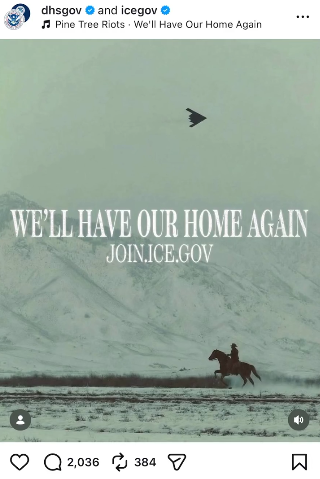
Trump’s federal agencies love putting catchy songs alongside their content on social media. While they usually post pop songs, phonk edits, or whatever viral sound is hitting on TikTok six months prior, on January 9, the DHS and ICE jointly posted an ICE recruitment image on Instagram with a song called “We’ll Have Our Home Again,” attributed to an artist called Pine Tree Riots.
The Instagram post (which was reproduced elsewhere, including X) featured an image (reproduced below) depicting the silhouettes of a figure riding a horse on the ground and a B-2 Spirit flying in the opposite direction in the sky. A snowy mountain serves as a backdrop for the all-caps message “WE’LL HAVE OUR HOME AGAIN.” The audio in their post covers the chorus of the song, which reads:
Oh, by God we’ll have our home again, by God we’ll have our home
By blood or sweat, we’ll get there yet
By God we’ll have a home
This song, as known by researchers and reported by The Intercept, is a neo-Nazi anthem, popularized in the time before the January 6 Capitol riot by a handful of far-right activists. It was later deployed alongside (now deleted) montages from cells across the right, including the Proud Boys after Trump’s 2020 electoral loss. The version I remember coming across back in 2020 was written by Mannerbund (from “Männerbund,” German for “men’s alliance” with völkisch connotations), a band with associations to literal fascist movements that I’ll untangle a bit below. But first, some ICE/DHS/Fed context.
Music and Trump’s Shock Troops
Audio trends, including songs, have dominated short-form video content for brands online, whether one is posting on TikTok or Instagram Reels or Twitter (or Facebook Reels, I guess). Federal agencies, especially but not exclusively under Trump’s second term, have been using the expectations of these platforms to drive engagement on their posts. The “We’ll Have Our Home Again” post is the most recent in a string of dozens of posts featuring song clips, often constructed to make ICE agents look cool, masculine, and tuff and non-white people look pitiful, stupid, and deserving of state violence.
While this is extremely unlikely to happen in the “We’ll Have Our Home Again” post, ICE has gotten into hot water for featuring songs without permission. Some examples:
- In December, Sabrina Carpenter ratio’d the White House for using her song “Juno”, leading the White House to delete their tweet after she called the video “evil and disgusting”. SZA did the same over ICE using her song “Big Boys” in a “Cuffing Szn” edit, calling it “Evil n Boring”.
- In November, Olivia Rodrigo similarly called out ICE for using her song “All-American Bitch” in a video encouraging undocumented Americans to “self-deport”.
- In October, MGMT got an ICE video featuring their song “Little Dark Age” taken down over copyright infringement.
SZA, in her tweet about her song being used by ICE, aptly described the seeming strategy of the authoritarian agency, writing: “White House rage baiting artists for free promo is PEAK DARK”. On some level, the ICE/DHS/White House web admins are aware of how outrage cycles can lead to a viral post. The social media managers for all of these US Government accounts are trying really hard to copy online trends, using viral sounds from TikTok on more unc-laden platforms like Instagram and X, where they are likely to both find a target audience and get lambasted (and shared) by critics.
While engaging in this way, these agency accounts are also smuggling in imagery that is deeply tied to racist and violent ideology and actors. This includes images that evoke the Agartha meme, Frontier/civilizing mission art, and terrorwave aesthetics (both the deleted MGMT video and several others). The Department of Labor is posting a true deluge of AI-generated propaganda that looks straight out of Nazi Germany and indeed they also posted on January 10 a social media post reading “One Homeland. One People. One Heritage. Remember who you are, American,” an almost direct analog to Nazi slogan “Ein Volk, ein Reich, ein Führer” (One People, One Nation, One Leader”). Union leaders have responded, calling out this fascist imagery.
While SZA, Sabrina Carpenter, and others have rightfully called out these agencies for using their (not fascist) songs to further a far-right agenda, the agency has also posted questionable songs in the recent past, too. For example, in October of last year, Border Patrol posted a reel of their agents doing stuff in cars in the desert, with a Michael Jackson track playing in the background. However, the song from the now-deleted post was Jackson’s “They Don’t Care About Us”, specifically focused on the following lyrics:
Jew me, sue me, Everybody, do me,
Kick me, k*ke me, Don't you black or white me.
These lyrics are blocked out in the version of the song that most streaming platforms serve their users, where a glitchy sound effect blocks out both the word “Jew” and the slur in the following line. However, in the clip that Border Patrol posted, these words could be heard clearly.
Posting these uncensored Michael Jackson lyrics is disturbing, but the Mannerbund song is a substantial escalation of song as rhetoric, which I’ll explain by giving background on the song and those who have pushed it.
Mannerbund: A Brief History and Legacy
As mentioned earlier, the ICE/DHS post attributes the song to “Pine Tree Riots”, a reference to a colonial America resistance movement from which the “An Appeal To Heaven” flag (as re-appropriated by Dutch Sheets for contemporary Christian dominionist movements) originates. But, as Dan Collen points out, the audio for both the original (Mannerbund) version and the contemporary (Pine Tree Riots) version are identical. I agree with Dan that this “suggests… that PTR is a simple pseudonym”, and the implications of these very powerful and violent agencies posting a song explicitly credited to a literal neo-Nazi movement are dark.
As I mentioned earlier, “We’ll Have Our Home Again” is deeply connected to the far-right. Social listening company Open Measures posted a graphic showing that 450 posts in their dataset mentioned the song’s title/chorus/core message. In Open Measures’s words, “Nearly all the posts we found were from explicitly neo-Nazi and white supremacist channels. And a review of our datasets found it hasn't circulated much outside those circles.” ICE/DHS posting this song is an escalation of their aesthetic commitments, this time through yet another problematic song on their socials (and significantly worse than the already egregious “Jew me, sue me” uncensored slur moment last October).
A History of the Mannerbund
In September 2020, someone posted a thread on 4chan’s /pol/ board with a link to a Vocaroo link to the song and some of the lyrics of a verse and the chorus. The post, which is reproduced below with some redactions, was shared by someone with a white supremacist flag (the symbol next to the post number). It also included an adapted version of The Great Wave off Kanagawa, a 1831 woodblock print by Japanese artist Hokusai, edited to have lines across the waves mimicking the copper traces on a circuit board and notably with a sonnenrad slightly off-center in the frame.
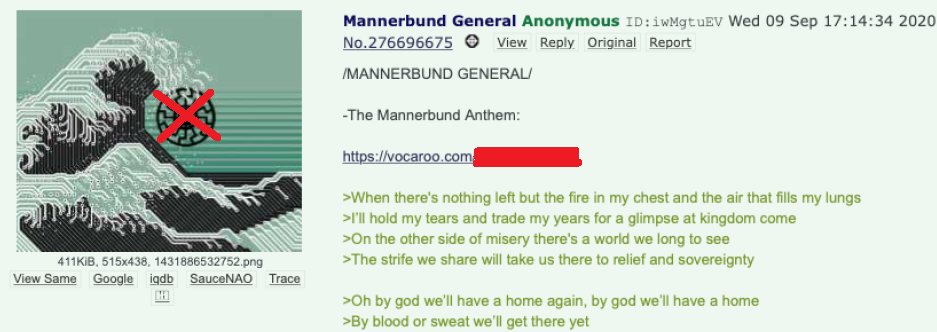
An immediate reply to this post (likely by the same creator) then posted a call to action, calling on other fascists to link up and start organizing. The song is clearly linked not just to the aesthetics of fascism but to the imperative towards action.
Key far-right social media platforms, including fascist projects like The Right Stuff and the National Justice Party, shared links to a site for the eponymous body that “The Mannerbund Anthem” (as it was called in the above /pol/ post) served. This song was not just a song, but connected directly to an authoritarian rightist project with calls to action that predate the anthem by at least a year. A 2019 post on an associated website for the group calling itself The Mannerbund describes the need (and ability) to “begin our grand project,” which involved joining a “pro-White fraternal order,” itself “the seed of an eventual government.”
The Mannerbund (the movement, not the artist alone) was a bit of a flash-in-the-pan organizationally, despite attempts to revitalize the network in the years since 2021. Beyond creating this song, some of their biggest influences in the white nationalist movement involved bringing back to light many of the speeches of The Turner Diaries author and neo-Nazi activist William Luther Pierce.
Much of The Mannerbund’s web presence has been severely degraded due to take-downs, deletions, or negligence, but archives of their activity are searchable for researchers seeking more information on just who the DHS/ICE boosted this week. The rest of this history is from this partial archive, so it is only a representation of the group’s production rather than a complete history.
The earliest version of “By God We’ll Have a Home” was posted in May 2020 by a (now-deleted) Twitter account connected to The Mannerbund. It included footage from the infamous tiki march at Unite the Right. This version is a bit sketchy, with the same lead singer but a much smaller group of backing guys (singing in varied levels of in-tune) and a much louder stomping rhythm. In a reply to response to their tweet, The Mannerbund confirmed that the song was “Sung and Written by a Brother of the Bund to the tune of Old Maui”.
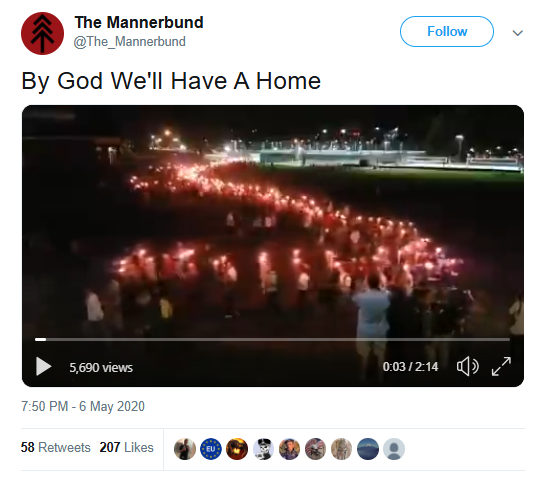
The connection to Unite the Right isn’t incidental, either. There are a handful of other songs by the same band, including an adapted version of “Drop of Nelson’s Blood”/”Roll the Old Chariot Along” with a verse that includes the lines “well another Charlottesville wouldn’t do us any harm,” taking Charlottesville to mean Unite the Right, the lethal rightist gathering that took place in the Virginia city.
“We’ll Have Our Home Again” was also uploaded to Spotify by a “verified artist” using the name “Pine Tree Riots,” the same as it appears in the ICE/DHS post. As it exists on Spotify, the song has an October 2020 copyright, a month after the /pol/ post above. The song credits the record label for the song as “Records DK,” a detail that indicates the song was self-published using DistroKid – not a surprising detail, but one that confirms the informal nature of this song. The Mannerbund likely chose to publish the song under the Pine Tree Riots name in large part to avoid platform bans, should the political group come under public scrutiny.
The earliest version of this song on YouTube that I’ve yet seen is a September 23 upload, 2 weeks after the /pol/ post. The video has now been removed. In a November 2020 post, an associate from The Mannerbund network used it as an example of a video that should be downloaded, archived, and shared peer-to-peer. It’s important to recall, though it feels like a century ago, Meta took action against what it called “militarized social movements” in the fall of 2020, leading to mass disruption of mostly militia groups on Facebook but reverberating through much of the right.
The song was also uploaded on YouTube on a channel with the current name “Pine Tree Riots.” Previously, the channel had the name “Just Thomas” and appears to belong to someone who has no detectable formal connection to many of the organizations I mentioned earlier. People responding to coverage of ICE/DHS’s post have come to this YouTube channel to post things like “Who’s here because of the DHS tweet?” and have earned replies from the channel owner. In an earlier YouTube description for the video, Thomas wrote the following about his reposted video:
Official anthem of The Mannerbund, written and sung by no one in particular.
Original tune is Old Maui.
Strength and Honor, brothers. Find your Mannerbund.
Email me at [redacted] if you're interested in collaborating on song projects!
Thomas, like the old Mannerbund Twitter account, confirms this link, but as has been reported in places like Newsweek, the melody of this chorus is almost an exact copy of an old sea shanty called “Old Maui” or sometimes “Rolling Down to Old Maui.” Listen at :30 to this 2016 arrangement by The Longest Johns, for example:
Note: I choose not to link the Newsweek article because it, as expert Dan Collen has skeeted, misrepresents the Nazi reality of this song.
A handful of writers have written about sea shanties’ popularity in the years around 2020, and their presence was ubiquitous enough on the internet that this shouldn’t be read as an indictment of sea shanties. Instead, this is a case of a white nationalist responding to a sea shanty with contemporary popularity by making his own version of the song with explicitly white nationalist lyrics. It’s part of a trend in the right-wing where a hat tip towards so-called ‘tradition’ often involves misinterpreting, remixing, or combining different disparate cultural artifacts from different masculine traditions (be those German warrior bands, Norse Pagan symbols, or sea shanties, all of which appear in the aesthetic lexicon of The Mannerbund).
Enduring Presence of Mannerbund
I remember coming across the song in a few dozen fascist montages on alt video site Odyssey back in the period of 2020-2022. Usually, these videos were for small groups of men who wanted their unpopular fascist message to look cooler by adding a shouting song in the background.
As Abner at Left Coast Right Watch wrote back in 2022, a right-wing journalist used the song in a promo video for Proud Boys, leading to his eventual firing from KOMO News. The journalist, Jonathan Choe, was a Seattle reporter known by locals and outside observers alike for his harsh narratives on the unhoused population in the Pacific Northwest city. There’s perhaps more to say on how years of inciting coverage had little impact on his career prospects, but the use of a Nazi song led to his career stutter – and maybe more to say about how the state’s politics have shifted when a federal agency is now posting videos with a song that got a reporter fired less than 4 years ago.
“We’ll Have Our Home Again” has connections to literal racist mass shooters, too. Ryan Christopher Palmeter, the 21-year-old white nationalist who shot and killed three Black people at a Jacksonville Dollar General, included lyrics for the song in his manifesto. This has been reported on in the past and comes up when Googling the song (prior to the ICE/DHS post), so it’s a detail that the social media manager for these federal agencies probably could have or should have checked, but more likely one that they already knew.
The Trouble in Contemporary Context
The trouble with Mannerbundposting by ICE/DHS is multifaceted. First, it’s not an isolated incident. There’s a documented history of the agencies posting deeply problematic stuff on social media. Second, their social media managers are using outrage cycles online to seek amplification of their recruitment posts. It is completely normal to see a fascist post and feel a deep emotional response (anger and disgust alike), and these agencies are betting on those responses when creating content like what I’ve mentioned here. Third, ICE/DHS is contributing to the normalization of racist, conspiratorial, and violent content online. They are unafraid of appearing to boost white nationalist talking points and aesthetics, and continue to repeat such posts seemingly in an effort to shift the Overton window on this type of antisocial social media engagement.
All of these types of engagements are doubly worrying because it often feels like there is very little that we -- those opposed to fascism, state violence, and racist edgelords -- can do in the face of such technical engagements (I wrote a bit about this on WXQT). It’s worth remembering, even if it feels like cope, that a feeling of hopelessness is a weapon of the authoritarian state. These people want you to feel overwhelmed and powerless, like we are outnumbered by freaks. While it is factually true that ICE has ballooned its staff significantly (in large part due to even further erosion of hiring standards) and deaths under their hands have risen, they have struggled to attract talent and are now wasting piles of taxpayer money running shitty fascist ads online.
I am not making any direct accusations of any individual here, but I highly doubt that the people involved in the decision-making process of posting this song were so naive as to not know what this song is, where it came from, and what it means (it does state that politics quite clearly). However, even without all of this context, the lyrics speak to the specific type of white supremacist, xenophobic, and chauvinistic agenda that these agencies have fervently voiced since last year. These agencies’ connection to these agendas didn’t start with Trump, either, as the DHS and ICE are both deeply problematic agencies created out of the reactionary and hateful environment post-9/11, intended to harass and violate those deemed too ‘foreign.’
I understand this whole post is describing the specific extremist origin of this song and why that’s troubling, but I also recognize that we are in the midst of one of the biggest waves of calls to abolish these agencies (especially ICE) that we’ve seen since their creation. The Department of Homeland Security was founded in November 2002, and ICE was founded in March 2003. In 2002, Nickelback’s song “How You Remind Me” was the year’s top-performing single. If you heard Nickelback playing on the radio, chances are you were hearing that band before the DHS or ICE existed. These agencies are our current reality, but they haven’t always been our past and don’t need to be our future, either. After probably listening to all these Nazi songs, maybe you should take a break and listen to Chad Kroeger sing that song instead:
Thanks to Dan, Liz, and Peter Smith for their clarifications and guidance on the Mannerbund song and network. Thanks to Travis Brown and a handful of unnamed researchers for their open-source help. Thanks to Faine for pointing me towards this post. You can read Faine’s blog here. These people’s insights were helpful, but all views (and mistakes) are my own.