Protesting Azeroth: Notes from a conference paper
This post is a companion piece for a paper I presented on player protest in World of Warcraft.

This post is a companion piece for a paper I presented at the Pop Culture Association conference this week. It connects to and overlaps with but is distinct from a paper presentation I gave in February. If you'd like to read the summary of my previous paper, on nostalgia in World of Warcraft, you can read it here:
 hampton.
It's not controversial for me to say that gamers in general and World of Warcraft players in particular have no issue complaining online. In cases where the game pace is slow or a player's main class gets nerfed or a beloved character has a weird story beat, WoW players have taken to forums and social media to voice their distaste for recent issues in the game.
My paper, however, focuses on protests and other disruptive behavior within the game, often (but not always) in a way that mirrors IRL embodied protest and direct action. This shift matters, as it suggests that players conceptualize Azeroth as not just a product they consume or a source of entertainment, but a space and place they inhabit with a community of peers, opponents, and developers who serve as an audience for their argumentation.
Between roughly 2020 and 2022, WoW players repeatedly protested within the game itself, both replicating protest methods outside of video games and also using the technics of the game itself to protest.
Protest Cases
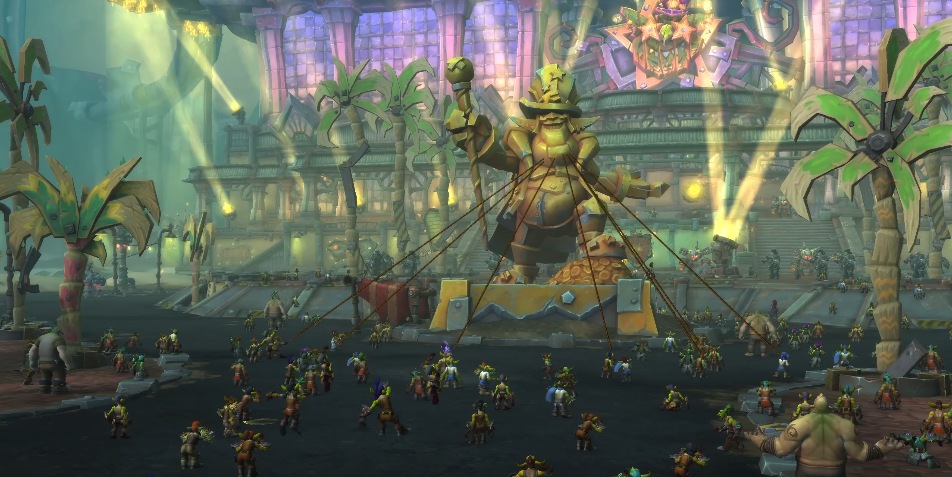
Instead of limiting dissent to texts and posts, players began experimenting with embodied actions inside constrained systems. A group of players organized a sit‑ins at the capital city of the expansion at the time and organized a march through a faction's capital city. The causes of these demonstrations were specific but different (bad behavior of Blizzard developers on one hand and disagreement with the story direction on the other). Another type of protest, those using the technics of the game, also have become common but these explicitly target other players: setting up an automation to use the /spit emote to target players who paid for a character boost in the game's Classic mode and spamming groupfinder tools to render them useless to other players.
In‑game protest produces screenshots, clips, and moments of friction that then circulate outward, pulling developers, journalists, and other players into the conversation. Those that target other players lead to a similar outward circulation, as players complain, ridicule, or voice support for such disruptions. Across these cases, protest wasn’t about winning so much as interrupting normal play and making dissatisfaction impossible to ignore.
The MMO Screen + The Micropolitical
These player actions make more sense if we stop treating WoW as a fictional backdrop and start treating it as a screened public space. In this sense, I draw from the work of Kevin Deluca & Jennifer Peeples, who theorized the 'public screen' as adaptation of Jürgen Habermas's 'public sphere', describing seeking screened attention as the way to force discourse around an issue of merit. MMO players do something similar, but may achieve their discursive goals through in-game actions meant to garner attention and conversation. Players escalate behaviors to create moments of spectacle, friction, and congestion that demand such attention.
At the same time, these protests are micropolitical, as described by such theorists as Jeffrey Pfeiffer. They look like politics, but their scope is tightly bounded. Players aren’t trying to overthrow a government or really effectuate true social change, but they’re trying to influence design decisions, narratives, and monetization schemes while voicing community grievances within the confined system of the game of World of Warcraft.
We know that players already possess the organizational skills required for this kind of action. Raids, guild events, and even pick-up-group content in the world (like world bosses and group quests) have trained players in coordination, timing, spatial awareness, and role differentiation. Protest borrows from these same competencies and repurposes them towards something that isn't tied to player progression.
In summary, here are a few of my takeaways:
- WoW protest is spatial. Hubs, game interfaces, and emote proximity all point to time, space, and place.
- Presence (and disruption) in gaming is argumentative. Players take up space in cities and within group tools, and this presence itself is rhetorical.
- Players already know how to organize. Protest is just another coordinated activity within the micropolitical frame of the game world.
If you attended my paper talk, thanks for coming to my site! Consider signing up for my newsletter if this kind of content is of interest to you: