Reanimating the Bones 2: Death and Tourism in the Music Scene
Hayley Williams's "True Believer" contends with the dynamics of tourism and death in her city of Nashville. This second of several essays examines how.

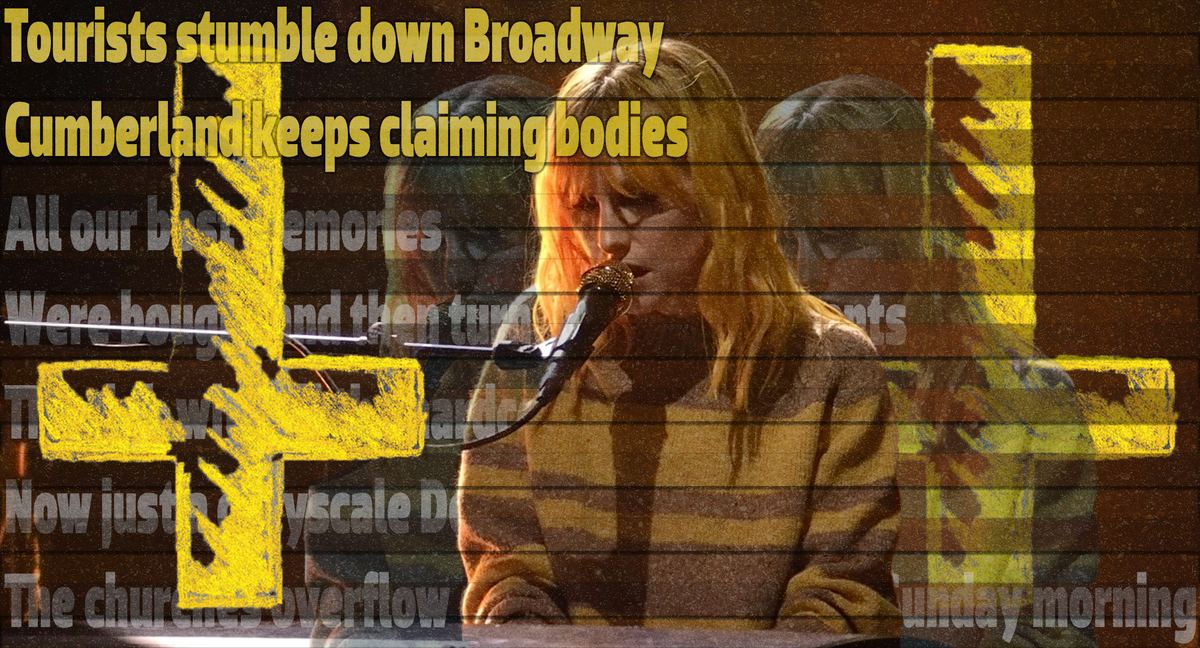
This is the second mini-essay analyzing some of the lyrics and arrangement of Hayley William’s “True Believer”, a song from her newest solo album Ego Death At a Bachelorette Party, which she performed on Jimmy Fallon’s show in early October 2025.
If you’d like to read the introduction post to this series of posts, I wrote an intro you can read here:
 hampton.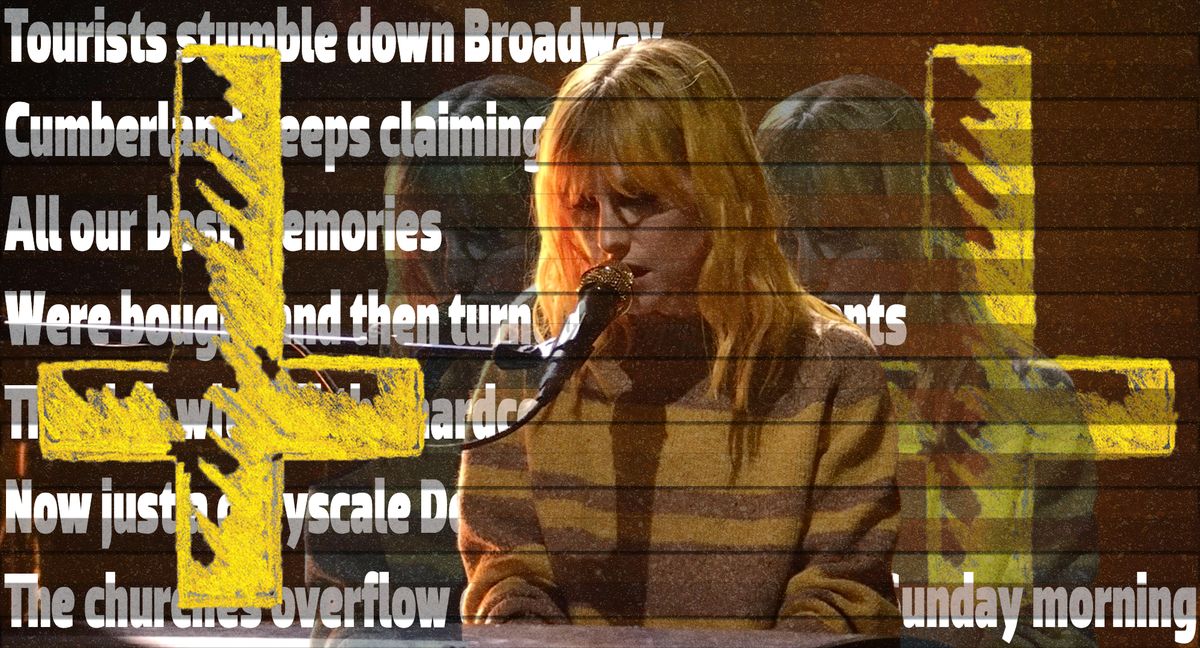
The Eldritch Horror of the Honkytonk
From the very first lines of “True Believer”, Hayley starts her critique of the dark side of Nashville’s development:
Tourists stumble down Broadway
Cumberland keeps claiming bodies
The Lower Broadway district’s honky-tonk fantasy (midwestern bachelorette parties dressed in cowboy cosplay, drinking way too much) masks a darker reality: bodies have been routinely found in the nearby Cumberland River. For example, in March 2024, Riley Strain, a 22-year-old student from the University of Missouri, seemingly drowned after overconsuming. Strain’s story made national news, as footage of the tourist drunkenly stumbling downtown contributed to a story of horror after his disappearance. His family filed a wrongful death suit against Strain’s fraternity, alleging that when Riley was incoherent and clearly in need of help, they just continued partying Downtown.
It's not just Strain, though, as the river has led to a yet indeterminate number of accidental deaths and suicides, including as recently as this month. These deaths, like Strain’s, often go unresolved for not insubstantial periods of time, with loved ones, the public, and the police often contesting narratives of what happened. In April, a passerby found an unidentified corpse floating near the Sycamore Boat Ramp, which police determined had likely been under the water for a while before discovery. In May, a fisherman found the corpse of unhoused Nashville resident Kelton King floating in the river, his body revealing he was stabbed to death by an unknown assailant. In June, police pulled an unidentified corpse from the river near where they recovered Riley Strain’s body. In July, a fisherman found Christopher Jenkins’s corpse by the Rock Harbor Marina, fully clothed in all-black. In August, a passerby reported finding the corpse of John Lankford in a nearby creek. A few years ago, a teenager dumped the corpse of Josh Evans after shooting him to death (the shooter recently allegedly shot and killed Chris King, the founder of Snotty Nose Records and a close friend to Trippie Redd and Justin Bieber). While police were searching for Strain’s body in 2024, they found another unrelated corpse in the Cumberland River.
There is something deeply eerie about Nashville’s native river. Flooding in Middle Tennessee in 2025 likely led to a deluge of newly discovered corpses, as new flows of water dislodged bodies from where they might have been hitched below the surface. The churning wake of river barges also further contributes to this. While Hayley (and this essay) focuses on Nashville, the internet is awash with theories and meditations on river deaths and disappearances; take, for example, the flood of posts with dozens of comments on r/UnresolvedMysteries that mention rivers.
It really must be understood how deadly the combination of sites of overconsumption with a proximate body of water can be. The CDC says that 70% of deaths associated with water recreation involve drinking, half of water drownings occur in natural water like rivers, and nearly 80% of those who die from drowning are male. These combinations are specifically evoked in Hayley’s lyrical juxtaposition of tourists stumbling and Cumberland's claimed bodies.
Nashvillian Necropolitics
Philosopher Achile Mbembe articulated the theory of necropolitics in a 2003 article and in a 2019 book, building on Foucault's droit de glaive (the right to kill), to move our understanding of state power on bodies to be not only the ability to decide who to kill, but also who should be exposed to mortal danger and what might lead to their untimely death. Policy decisions are being made by Nashville’s city planners that lead to the enduring dangers of Cumberland's waters, yes, but in the second verse, Hayley continues her critique of city policy:
They put up chain link fences underneath the biggest bridges
Nashville's commercial appeal to tourists brings capital interests’ demands to remove surplus labor, inconvenient bodies, and informal encampments deemed detrimental to the territories of commerce. 2025, when much of Hayley’s album was written, has been a landmark year for encampment closures, hostile policy, and throwing-the-baby-out-with-the-bathwater ass policy:
- Nashville authorities fenced off a bridge in the trendy Berry Hill neighborhood in March.
- Tennessee’s legislature passed an egregious new bill that obligates swifter clearance of the unhoused.
- The Nashville Department of Transportation also continues to remove benches from public spaces, increasing the suffering of vulnerable people while also making all of public life more inaccessible and hostile towards those living in
Later in her song, Hayley uses the phrase "hard bargain" as a double entendre, pointing both to the difficult Southern social contract and a traditionally Black neighborhood in her hometown of Franklin. Formerly enslaved man Harvey McLemore founded Hard Bargain on land he purchased from his enslaver, Judge W. S. McLemore. Harvey then sold lots in the neighborhood to other freed slaves, creating a thriving Black community across 15 acres in downtown Franklin, now known today as the Hard Bargain neighborhood. It is now being heavily targeted by the forces of capital for gentrification. Still, community organizations, including the Hard Bargain Association, have been fighting to keep its character intact and history honored.
Those with power -- both those with access to state power and those with access to capital -- make decisions essentially every day about who gets to be protected from exposure to things that will shorten their lives. These decisions may not be at the top of the priority list when they make these decisions, but where the necropolitical components of Nashville policy become clearest are where they are moving to make even more vulnerable the people in the city who are the most marginalized and exploited.
The clearances of informal encampments under these bridges and the corpses in the river are related to the death that is deemed permissible in Nashville, all in service of making money in a plastic music scene propped up by racist country singers and out-of-town developers. I mentioned Kelton King earlier in this post, whose body was found in the Cumberland River after an unknown assailant stabbed him to death. King was identified after his death in part because people of Nashville knew him. Ray Dipietro, a Nashville photojournalist, posted in August on his Instagram a mourning and memorial for a man he considered part of his neighborhood and community. It’s hard to know how many people displaced from shelter underneath a bridge may have faced a similar fate, but it is abundantly clear that the powerful in Nashville don’t care to find out, much less stop the forces that increase the chances of this happening.
Thanks to AC and DM for their thoughtful comments on an earlier draft of this post. All mistakes are my own.