More Trouble with the Belfast Pogroms: Examining Loyalist Bonfire Sites as Marching Season Kicks Off

Prior to the violence in Belfast this week, a flyer circulated all across Northern Irish social media and in group chats, which identified 26 “road closures.”
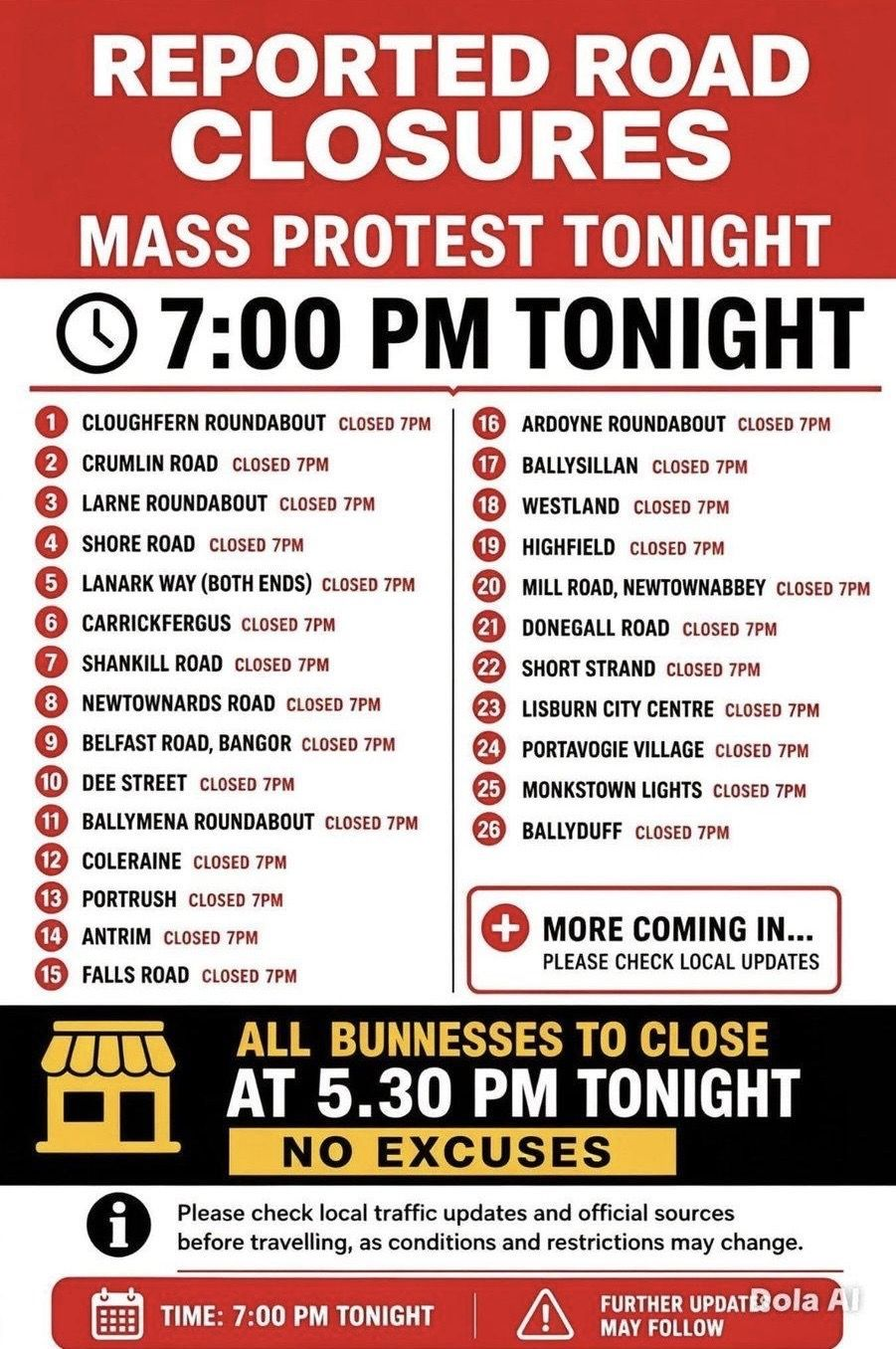
The flyer, which appears AI-generated due to the watermark “Dola AI” (likely referencing the international version of ByteDance’s Chinese AI app, Doubao, which originally launched as Cici in August 2023) and weird typos/spacing (“BUNNESSES”). A mass forwarded WhatsApp message with the image included the following accompanying text, too: "please forward all men of the age of 18 and over. Wear dark clothing… and be prepared to fight or be arrested." The flyer ominously says all businesses to close, “NO EXCUSES.” These 26 locations may look random to an outside observer, but they are immediately recognizable as falling into two major camps: deeply loyalist areas or areas that represent interfaces between Catholic and Protestant areas.
In lamenting the violence of June 9 in Belfast, wherein a mob of black-clad men smashed windows, broke doors, and started numerous fires in refugee and immigrant neighborhoods, Labour chairwoman Anna Turley blamed social media and pointed to Elon Musk’s role in stoking divisions. Journalist Adam Bienkov skeeted, however, that Prime Minister Keir Starmer’s office was reporting no change to their government’s policy on using Elon Musk’s site in the wake of the violence. If the platform continues to be such a problem, why official channels (on both sides of the Atlantic) are so committed to using it as a primary means of communication is puzzling, but I digress.
This mob violence, while joining a pattern of anti-immigrant, anti-refugee, and anti-foreigner violence and threats from the right in the UK and Ireland, arose in retaliation for the attempted murder of Stephen Ogilvie by Hadi Alodid, who is Sudanese. Ogilvie’s family has loudly said that the violence against him, a “terrible tragedy,” should not “be used to divide people or fuel hostility.” Early reports claimed Alodid was of Somalian descent, a favorite nationality for online racists to target. Ultimately, Alodid’s nationality only matters in its proximity to whiteness, however, in that he is excluded from whiteness by the very nature of his skin. This is why, for example, there hasn’t been outcry from UK communities over the recent attempted beheading of a Kurdish man by a neo-Nazi or of a white woman killing her Malaysian friend and forging her will.
While there certainly are many reasons to blame Musk’s hellsite and the cretin himself, and indeed Musk’s amplification of people like Stephen “Tommy Robinson” Yaxley-Lennon does not help, this week’s specific bout of violence was likely organized locally within loyalist paramilitary spaces and their networks. This is apparent in where the pogroms happened and where the call-to-action messaging targeted, as it appears in the AI-generated graphic that leads this blog post. Neither X nor Musk's cheering for civil war helped the matter, but both would have had little impact had the grounds for violence not already been fertile.
Trinity College Dublin professor Brendan Ciarán Browne wrote a great reflection for The Conversation, which draws the connection between this week’s violence and the violence of the Troubles. It’s worth the read. This connection is extremely relevant, and my blog post here dives a bit deeper into how this mobilization is primarily a problem of the hateful violence of loyalist communities in the Irish North. The evidence here is clear, but brought into clarity in part through some data on loyalist activities I’ve been tracking for a decade.
The attacks
The evening of June 9, violence centered on three areas: Crumlin Road, Newtownards Road, and Shankill Road) On Crumlin Road, which is a key interface between Catholic and Protestant areas in North Belfast, the mob lit multiple fires. In Newtownards Road in East Belfast, they burned houses, cars, and a bus. Attackers in Shankill Road lit vehicles on fire and attacked businesses.
The violent scenes were deeply chaotic yet had an obvious air of coordination. Along the Lower Newtownards Road, masked men shouted for foreigners to get out, banged on doors, and smashed windows. The mob burned at least three houses, a Middle Eastern supermarket, a Glider bus, and numerous vehicles. In Ballyclare, they also attacked a Turkish barber shop. The characteristics of these attacks (shouting for foreigners to leave, targeting a Middle Eastern supermarket, attacking a Turkish barber shop) give clear indication that this is a racialized series of events, a pogrom intended to extricate non-white populations from areas of Belfast (and beyond).
June marks the start of what many folks in Northern Ireland call “marching season,” which culminates in the Eleventh Night celebrations observed by Protestants on the evening of July 11. These bonfires, which celebrate William of Orange’s July 12 victory over the Catholics and therefore burn in effigy the whole of the Catholic population, often correspond with sectarian violence, including window smashing, fires, and attacks on Catholic individuals. I have been tracking loyalist bonfires for a decade now, keeping up to date on where new ones have popped up and logging whatever hijinx the organizers have gotten up to at their bonfires (many such cases!).
It is perhaps no surprise that of the 26 locations from the closures flyer, all but three are either literally confirmed sites of loyalist bonfires (14) or interfaces that lead to bonfires (9). The three locations that aren’t bonfire sites (Falls Road, Ardoyne Roundabout, Short Strand) are in heavily Catholic areas and should be understood as areas that loyalist groups are pressing against. Also, Short Strand has a bonfire on a loyalist street that comes very close to it, so excluding it is just out of an abundance of caution (though there is strong argument that it ought to be counted as a bonfire site, too). Since I have tracked bonfires since 2017, I can also tell that the closure map has a recency bias as it seems to overlap more with the currently-active bonfire sites rather than those that maybe have lapsed in recent years.
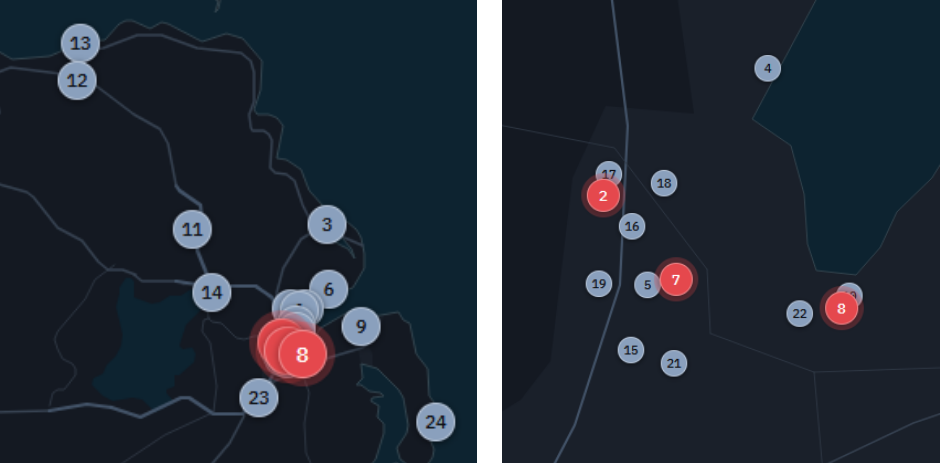
Zooming into Belfast, it becomes quite striking how these closures also pretty neatly map out the territorial borders of loyalist areas in the city. These closures ring Belfast’s loyalist areas in the North, West, and East of Belfast almost completely while including a few interfaces to intersect with nationalist areas. The citywide dispersal of these closures is, therefore, also an outline of borders (rather than a randomly scattered series of points).
The recent knife attack occurred in north Belfast, and no planned demonstration from this flyer (nor Eleventh Night bonfire) appears to have happened in the immediate vicinity of the attack.
The pattern
Sinn Féin leader Mary Lou McDonald went on the record saying that the violence in Belfast was “orchestrated by loyalist and far-right thugs”. First Minister Michelle O'Neill called it disgusting cowardice, and SDLP leader Claire Hanna called it a race-based pogrom. Loyalist politicians have stayed largely silent on the matter, especially in the paramilitary-aligned communities (notably, DUP Deputy First Minister Emma Little-Pengelly has denounced it).
If the bonfire locations and politicians’ statements aren’t enough to convince you, we can look back at a few other previous similar events from last summer.
Almost exactly a year ago (9-18 June 2025), a similar upheaval wracked areas of Ireland after the alleged sexual assault of a teenage girl. The narrative spread that two Romanian-speaking 14-year-olds assaulted the minor, leading to a right-wing mob lighting houses and cars on fire. They also burned a leisure center in Larne that was sheltering immigrant families. Violence spread to Portadown, Belfast, Coleraine, Newtownabbey, Carrickfergus, Antrim, and Lisburn (you may note that many of these are named in the closure list above). Roughly two-thirds of Ballymena’s Roma population fled from the area.
The Committee on the Administration of Justice situated this prior week and a half of pogroms within a pattern of far-right anti-immigrant violence in Northern Ireland since 2023. They show that this pattern of violence concentrated in areas with significant loyalist activity and confirm that it often appears timed to the aforementioned marching season.
About a month after the Ballymena escalations, the Eleventh Night bonfire at Moygashel made the news for featuring an effigy of a boat holding more than a dozen life-sized mannequins in life jackets on it. The boat had placards reading “stop the boats” and “veterans before refugees.” The PSNI investigated it as a hate incident, the Church of Ireland called it racist, and Amnesty called it dehumanizing whereas loyalists called it an “artistic protest.” Reuters connected this effigy to the attacks of the month prior in a well-researched piece. In May of this year, the Moygashel community put up a wildly racist banner on a play park fence, which the PSNI has been investigating as a hate incident.
The legacy
These effigies are common and often rely on hateful images (such as insinuating soccer players of African descent as monkeys) and have become all too normal in the loyalist scene. They are communicative in nature, figuring into a pattern of how loyalist communities in the Irish North engage in their exclusionary public rhetoric. This usually follows a pattern that starts with racist materials in public space and ends with intimidation of non-white people out of their housing.
As Lara Whyte has written for the Bureau of Investigative Journalism, this violence is deeply reminiscent of the Troubles (and, indeed, the years since!). The target has shifted from the Catholic neighbor to include the migrant, the Muslim, or the refugee. The territoriality, paramilitary coordination, flyering, seasonal timing, and targeted burning of homes are all part of a lengthy legacy of this kind of violence.
On June 10, someone circulated addresses where immigrants supposedly lived, which led directly to many of those homes being targeted in this week’s pogrom. Some may not remember the marked doors of the Troubles, but this functions similarly, turning a neighbor into a target. Loyalist targeting, while deeply hypocritical (as many have been willing to point out in comparing outcry over Ogilvie vs the dozens of women murdered by locals), has been patterned after decades of similar activity.
If you pull back Musk and the algorithmic amplification that X provides these days, you’ll find an older and more local mode of spreading targeting information. This includes a list of addresses, calls to prepare for violence, and returns to familiar rally points. Loyalism has always kept this list of enemies and for decades these names have been mostly Catholic. Their list has expanded to include other marginalized people, be they Sudanese or Romani, but the mechanism of hateful violence remains. That loyalist bonfires have not only remained in the 21st century but appear to be expanding in scope and size keeps the loyalist grudge alive, even if the Good Friday Agreement ended the Troubles three decades ago. This is a moment of crisis requiring decisive action, the first step of which requires naming this hateful series of attacks for what it is and where it comes from: a loyalist-organized pogrom.