My Time with Lindsey: Gunrunning, Doomsday, and the Iranian Bomb

Few people know this, but I was an unpaid intern in a local office for Lindsey Graham my first summer after starting college. I worked a few hours a week, filling time in the days while I ran the takeout counter at a local Thai restaurant in the evenings.
Graham, perhaps one of the biggest hawks in the US government history-to-date and a right-wing politician who has oscillated from Trump critic to stalwart defender of Trumpist policy (and even an advocate for a third Trump term), has died at 71 this past week. With his death now in the news, I wanted to offer some thoughts on my experiences in his office one summer nearly 15 years ago. Memory is fickle, but there were some things that really stood out to me from my short (and unsuccessful) stint in this small office.
I was the lowest level intern one could be, disallowed even from using office reserved parking (except for on two special occasions when someone more important was on vacation). I worked in a local office, one leased out of a building in a small but growing downtown area, which had essentially no connection to any of the policy work happening out of Graham’s DC office. Most politicians working at the federal level have at least one of these offices back in their districts (Graham had six at the time of his death, and I don’t recall the count while I was working there, but I assume it was around the same, if not slightly lower by count).
A Few Notes on Graham
Graham’s record is one of great shame, and he caused countless unnecessary deaths at the hands of the US empire. He died a coward and a zealot, and made choices that have harmed the people of the world, the residents of the United States of America, and his constituents who voted him into office again and again in South Carolina, the state where I spent most of my childhood.
He was born in Central, South Carolina, so-named because it was the center point of the rail line between Atlanta and Charlotte. Nowadays, most anyone traveling between these two metro areas is likely to instead drive up I-85, leading most to now consider Greenville the central point between Atlanta and Charlotte. Graham did not have an office in Central, but instead had one in Greenville, a county over.
After getting his law degree from the University of South Carolina, Graham actively worked on the legal side of things within the Air Force up until 1989, after which he jumped into politics to win a statehouse seat in 1992 and a U.S. House seat in 1994 (he remained a reservist in the Air National Guard and Reserve until 2015). He made a name for himself among what was really a precursor to the Tea Party, a group of Republicans who outflanked House Speaker Newt Gingrich for being too friendly to the Clinton administration (a wild detail to think back on today). In 2002, Graham won a Senate race for the seat vacated by segregationist and Jim Crow cringelord Strom Thurmond. The Associated Press has an obituary that covers all of the above and more.
After 9/11, Graham, John McCain, and Joe Lieberman campaigned for massive expansion of US intervention abroad. In the last 20+ years, I’d say they probably got many of their wishes, as the US has only expanded its military footprint abroad in my lifetime. Ever the strident hawk seeking new military engagements to sow death and destruction, Graham promised that “Cuba is next” barely 24 hours after the US began bombing Iran. His support for Israel was along the lines of the evangelical death prophecy, and he defined his support of the warmongering state as part of a “religious war” after October 7 (and called for Gaza to be flattened).
Graham was, at one time, celebrated by liberals as a right-wing voice against the rise of Trump. However, he pursued power when it served him, flip-flopping on Trump, on credible rape allegations, and on January 6. In May 2016, he tweeted “If we nominate Trump, we will get destroyed.......and we will deserve it.” Within just two years, Graham was one of the most aggressive defenders of Trump appointee Brett Kavanaugh in his 2018 confirmation hearings. After the January 6 attack on the US Capitol, Graham told Trump to “count me out,” but by the end of that summer he was already championing Trump in the press again.
Graham died in DC, having just returned from a visit to Ukraine, where he had announced another new round of sanctions targeting Russia. In the moments before his death, Graham apparently laughed off advice that he seek medical attention, saying, “I can’t die now. I still need to do the Russia sanctions, get Iran sorted out.” In his own words, he appears to have died after denying medical care in part because he had too busy a schedule arranging more violence — almost poetically seeming to have prioritized further death and destruction over his own health. Trump, in his newfound typical fashion of completely failing to read the vibe, lamented Graham’s death to NBC’s Meet the Press by saying it was “a big blow to the SAVE America Act.”
Casework and Calling Your Senator
The primary reason I thought I might spend some summer free time in Graham’s local office is that I thought I could get some good experience in the political world (the trajectory I was envisioning after the hope of Obama’s first campaign). I answered phones and sorted mail. I also fielded questions about and updated casework for VA and Medicare issues (this was the reason why I wanted to work in the office, perhaps under the misguided view that Graham was the best South Carolina option for VA casework – the options were bad to worse, even for my admittedly teenage outlook).
If you've ever worked a public line like the one I was answering phones for (not just at a politician's office but at a law firm or a clinic, one of which I have also done at least one summer of, too), you know some people will call on a weekly or even daily basis. Some of those who call are doing so out of loneliness, some out of boredom, others out of not knowing where else to go and believing that a powerful office could help resolve some of their imminent problems. At this office, we had two recurring callers: a lady convinced her neighbors were drug kingpins (I think they were just not white) and a mother of a Marine whose son came back from a GWOT tour different (the extent of his changes didn't seem limited to his mental state). I'm not sure if either of them ever got responses, surely none so quickly as the folded flags and Capitol tours I seemed to be helping facilitate.
When people began calling the office to voice their views on issues, I was asked – as an unpaid, part-time teenage intern – to start a "for" and "against" tally on a piece of scrap paper (I think this may be unfortunately a pretty common unpaid intern procedure, and not unique to tech-averse Graham, South Carolina, or the GOP). These tallies would then be shared in a staff meeting with the senator. I'm pretty sure I was awful at this fielding phones. I was bad at the whole job, actually. When I left for a week to vacation with my family in July, the office manager told me I didn't need to come back for my final four weeks. I'm unsure if my poor performance or my leadership position in my school's College Democrats (noted on the resume I submitted earlier in the spring) played a bigger role.
I remember getting a lot of calls about Obamacare (and the office had a large paper flip chart on a stand that had some tirade about the policy), with a substantial number of people calling to voice their opinion that the senator should be more supportive of healthcare expansion. I don’t, however, think these tallies mattered, given Graham’s record. Another big issue I fielded a ton of calls for – and this will come up later – was the Operation Fast and Furious scandal. This was the summer of 2012, after all, when Attorney General Eric Holder became the first sitting member of the cabinet to be held in contempt of Congress (on an essentially party-line vote). This gunwalking scandal, wherein the ATF let suspected straw purchasers walk away with about 2,000 firearms they expected to show up at crime scenes, was obviously sharkbait to conservative press looking for any reason to attack the Obama White House. Two of these guns, identified by their serial numbers, resurfaced at the scene of the murder of Border Patrol agent Brian Terry in December 2010. Fox News ran so much coverage of this scandal, and in so doing elevated numerous voices to their platform (including III% founder Michael Vanderboegh – more on that in future writing, though!).
The TV Diet
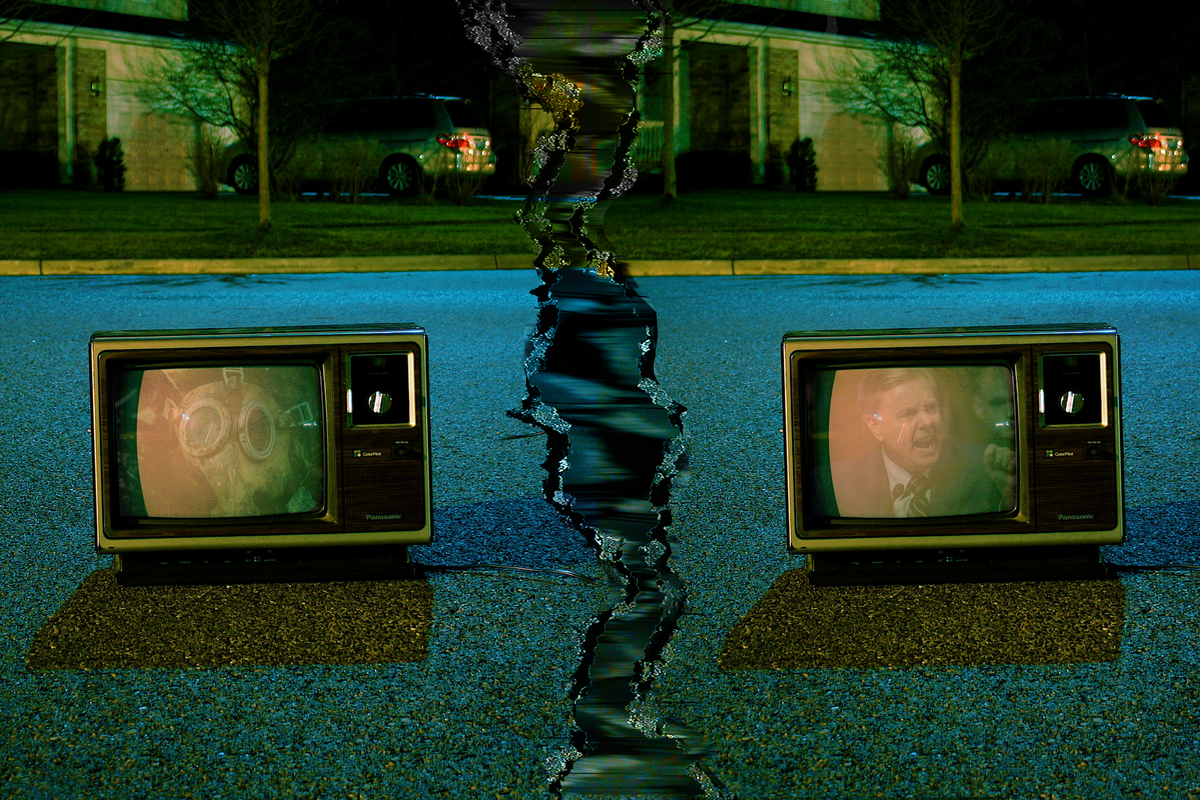
Speaking of Fox News, the office had a TV on next to my desk literally all day long. In all my life before and since, I don’t think I’ve ever seen the same few awful pictures of Eric Holder repeated over and over – usually with some scary marquee about arming the cartels in stories. Reflecting from today, these narratives seem eerily like nascent fringes of the so-called Great Replacement Theory that Fox host Tucker Carlson would mainstream within the following decade.
Other than Fox News, I remember distinctly watching on these office TVs a ton of Doomsday Preppers, a National Geographic reality show about those preparing for catastrophe. This show, if you’ll allow me the aside, is pretty important to how the apocalyptic right fits themselves narratively into the coming doomsday.
Doomsday Preppers isn’t the most creative show and follows the same general arc each episode: (usually) a man prepares for a specific type of apocalypse (EMP attack, pandemic, gun-grabbing government, etc.), shows off how he has prepared for his scenario, and then a panel of so-called experts on disaster and survival scores him on his odds. This loop, especially if consumed on a daily basis, reinforces two lessons – which are not-so-coincidentally the same lessons Fox News frequently communicates to its audience.
The first lesson of Doomsday Preppers is that the world is ending and it is ending at you, the viewer. In 1976, George Gerbner and Larry Gross argued that if you watch enough television, you start borrowing the worldview of the programming instead of the one outside your window. Heavy television viewers overestimate their odds of being victimized, want more policing, and are more likely to say that most people can't be trusted. Gerbner and Gross described a “heavy viewer” as someone who watched four hours of television a day (between Fox News and shows like Doomsday Preppers, this office cleared this count before lunch).
In 1981, Gerbner told a congressional subcommittee that,
fearful people are more dependent, more easily manipulated and controlled, more susceptible to deceptively simple, strong, tough measures and hard-line postures. . . . They may accept and even welcome repression if it promises to relieve their insecurities.
About three decades after Gerbner spoke to a congressional subcommittee, a local office of that same Congress was absolutely blasting fear-based media to its staff (full-time professionals and interns alike).
The second lesson of Doomsday Preppers is that the rational response to coming collapse is private, individual, and securitized. The rhetorician Casey Ryan Kelly wrote a worthwhile essay on this show (which contributes to his book, Apocalypse Man), in which he described Doomsday Preppers as portraying a set of rituals arranged towards a particular kind of manhood. On Doomsday Preppers, the future’s texture may shift between different apocalypses, but the answer is usually the same blend of aggression, stoicism, and competition. Kelly says the show’s valorization of the prepper then helps the men at home (or in this case, the local congressional office) feel vindicated, and thus want to watch more to further affirm their worldview.
The show does not really offer any insight into a functioning state, mutual aid networks, or trustworthy neighbors. It always recommends stockpiling (of food and ammo) and reinforcing one’s abode, rather than developing the human and collective network necessary to respond to such apocalyptic scenarios. This is all coherent with the right’s view of society, and connects to Graham’s Obamacare flip-chart. Obamacare is a safety net (admittedly a conservative plan for healthcare, since it is based on Romney’s plan) just like any of these communal responses — but Doomsday Preppers and Graham supporters alike believe that the world is divided between the deserving (or the prepared) and the doomed (the unprepared).
No episode of Doomsday Preppers ever ends with a family calling a town meeting or voicing their desire for a better local hospital. The advice of the expert panel is usually tied to consumption, with an expert telling the prepper what else he needs to buy for his bunker. It’s a show that communicates that no one will help you survive the apocalypse, but your salvation can come through buying more objects.
The Foreign Affairs Incident
Between fielding phone calls and updating casework files from an email inbox, I had a lot of time to read at the internship. I don’t think I ever saw any of my colleagues doing much reading, though perhaps the more senior people were reading behind closed doors in their offices. I don’t mean just books; I mean even online articles or news coverage – I think most of our analysis came through staff meeting verbal readouts and from Fox News all day long.
One day, I came to the office with a paper copy of Foreign Affairs (I thought it was what policy people read, and so muddled my way through the GWOT wildness of the magazine at the time). Perhaps I was doing this for the drama (I wouldn’t put it past myself), but I do not remember taking much thought over the cover of the July/August 2012 issue. I’m including it below, so you can see why this was perhaps a silly thing for me to bring into a room full of staff for one of the most hawkish Senators:
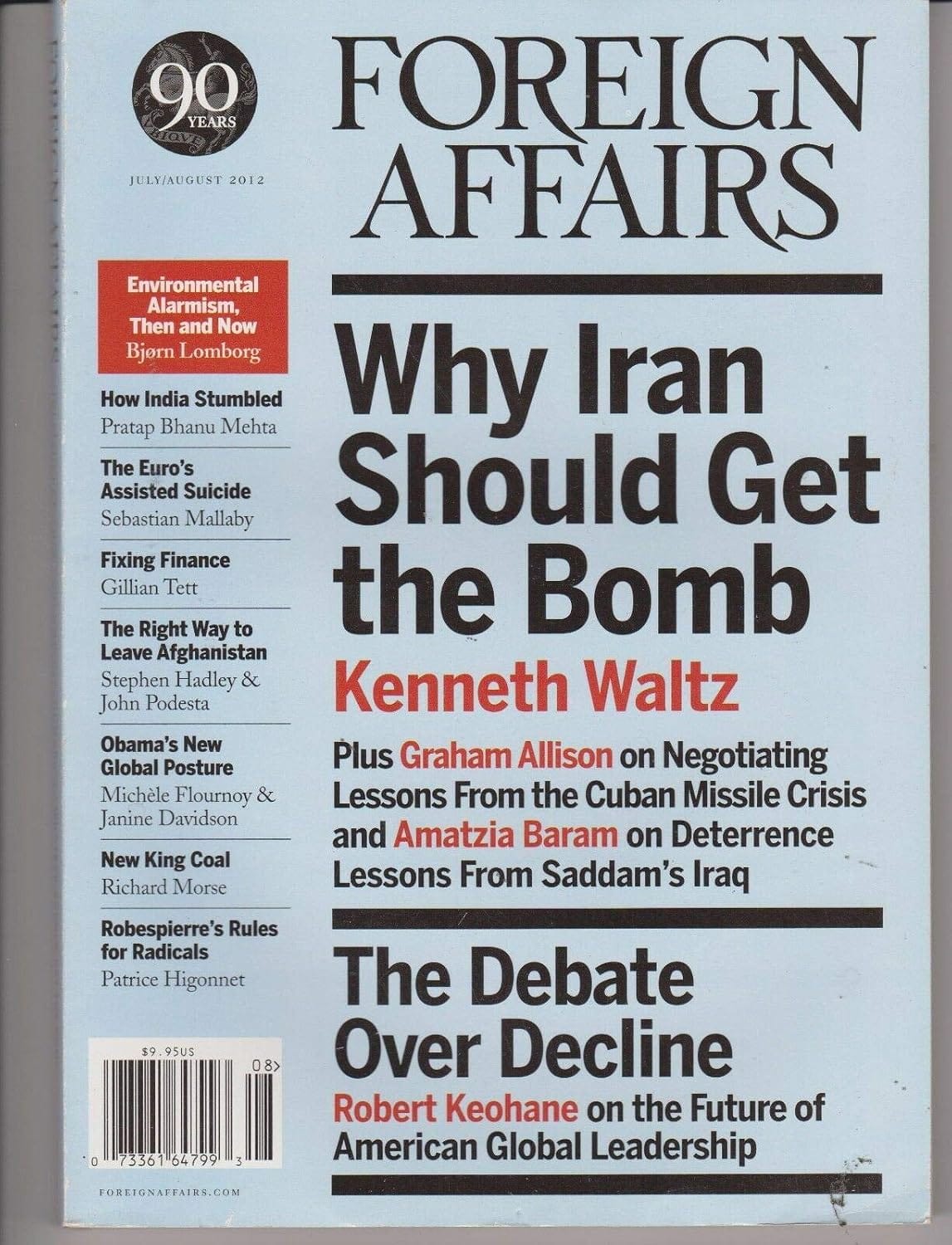
“Why Iran Should Get the Bomb” ended up leading to a pretty big argument aimed at me by a professional in the office who had a decade of work experience more than me. Waltz’s argument inside the article is about what one could expect of one of the founders of neorealism, but I don’t think anyone in the office would have read this article regardless. In subsequent years, the staff member would avert his gaze when we made eye contact at the church my family and his attended (until we left that church because the church’s pastor devoted "mission" funds towards digitizing the library of the Ivy League divinity school he attended).
Any political office has its customs and taboos, of course. I wasn’t pretending to be a right-winger, but everyone just assumed I was One Of Them and would share their really bizarre opinions (I’m not going to repeat them here unless I am misremembering or misrepresenting them – and perhaps they have changed their minds since[?]). I had clearly broken one such taboo by having this sacrilegious text, just as I had by refusing to eat the near-daily complementary Chick-fil-A breakfast biscuits (not only was I a vegetarian, but this was clearly Graham using CfA as a virtue signal that he opposed queer rights).
Closing Thoughts (Not a Eulogy)
Graham’s local office, for the short time I spent working as an intern there, was a deeply troubling ideological space. We watched simulated catastrophes on the television for entertainment while working for one of the men most responsible for catastrophic violence across the world (including systemically at home). Just as the preppers on the TV screens rehearsed for a coming collapse, Graham had a heavy hand in exporting the US military’s violence upon Iraqis, Gazans, Iranians, and more – and I don’t think the victims of his policies had much of the same allowance as the preppers on the TV.
On July 13, South Carolina Governor Henry McMaster appointed Graham’s sister, Darline, to his seat after Trump recommended her on Truth Social. She was sworn in on July 14 and will serve through January 3, serving as South Carolina’s first woman senator. She will complete her older brother’s term not because she is the best candidate, but because a mad king recommended her and family connections matter more to his government than policy experience. She is likely to approach her limited term by continuing what she believes Lindsey would have wanted — death abroad and the further erosion of our social safety net at home. What an apocalyptic vision.
Many thanks to Robin for her edits and to D, T, and W for lending their eyes to an earlier draft.