Living in the Ruins: Killer of Sheep, Still Life, and Urban Development

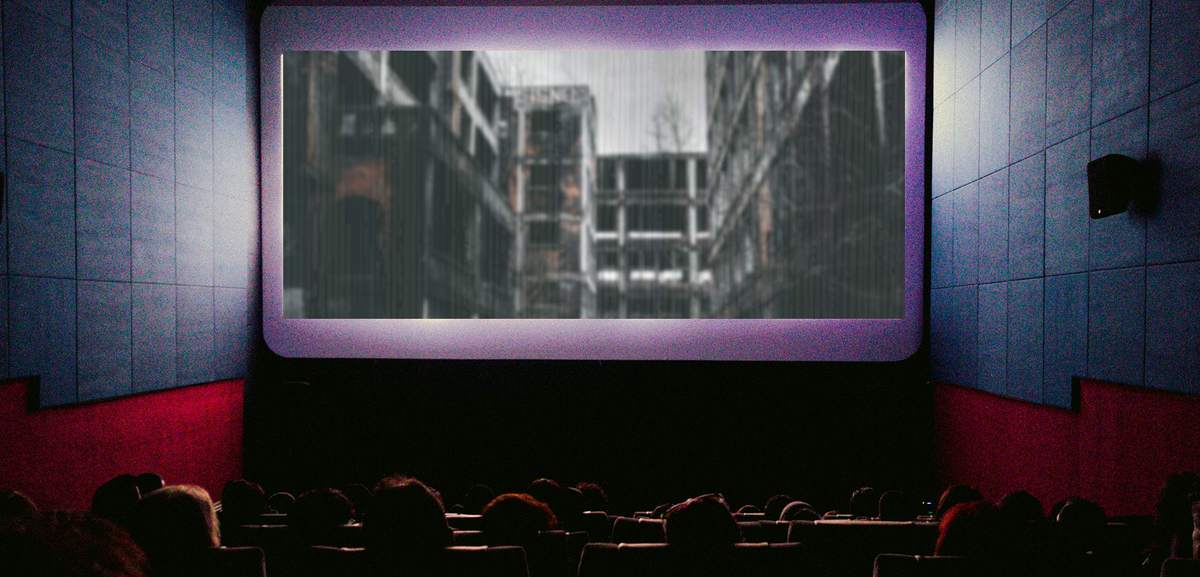
This blog post discusses the work of two very different directors, American filmmaker Charles Burnett and Chinese director Jia Zhangke. It includes light spoilers for Killer of Sheep and Still Life, so if that is something that worries you, please watch both movies before reading on (they are both worth it, I promise!).
Charles Burnett’s 1978 film Killer of Sheep and Jia Zhangke’s 2006 film Still Life have vastly different settings: the former takes place in Watts, California a decade after the Watts Uprising and the latter in Fengjie, China during the Three Gorges Dam project. These two films, separated by three decades and an ocean, both observe something similar about workers living inside the wreckage of someone else's progress.
Living Amidst the Ruins
In Killer of Sheep, those primarily interacting with the ruin of the city are children who play war in an empty lot in Burnett’s opening shots and play in an abandoned lot full of buildings in disrepair later in the film. In Still Life, protagonist Han Sanming joins a demolition crew for work, taking an active role in contributing to the destruction of his new residential home while he awaits news on his estranged wife and daughter. In both settings, the destroyed parts of these cities – one in an overwhelmingly working-class Black neighborhood and the other in a working-class Chinese city (the project displaced over a million people) – take on an almost post-conflict quality.
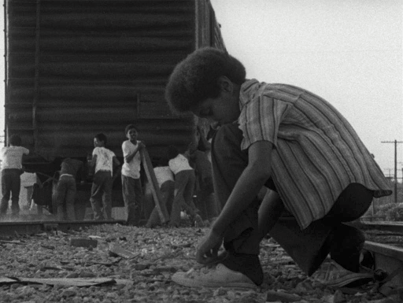
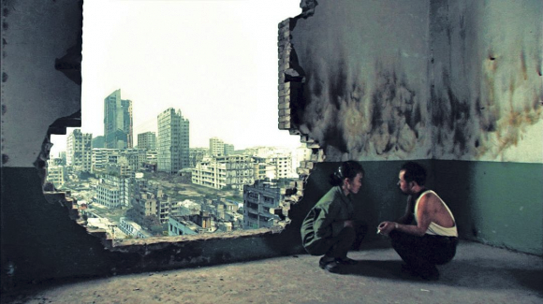
characters squatting amidst the ruins, in a still from Killer of Sheep at left and Still Life at right
The analogy of the city in the process of being destroyed as the bombed-out city is not unique to those lamenting the changes to our urban landscapes. In New York, A Documentary Film: The City and the World (1999), the talking heads discussed Robert Moses’s aggressive urban planning as doing what the Germans or Japanese ‘never could’ in WWII. The audience sees the forces of dramatic changes in property relations, often at the site of de-industrialization or intensification of industrialization, a state of exception for industrialization.
The Afterlives of ‘Creative Destruction’
Economist Joseph Schumpeter coined ‘creative destruction’ as a term for the crisis of sliding between periods of innovation, wherein a new technology/plan/idea begins to replace an older one. In this juncture, people are negatively affected while future ‘progress’ is wrought, often through the structural violences of slum clearance, de-industrialization, and the AI boom. The boosters of all of these developments, despite their immense human costs, would describe these shifts as creatively destructive, regardless of who captures the gains and who absorbs the losses.
Contemporary American conversations on blight, redevelopment, clearance, and gentrification contend with a tradition of what often is inappropriately summarized as the ‘necessary evil’ of ‘progress.’ Urban planners, politicians, residents, and developers have struggled with what progress means, on whose terms it should happen, and for the lives of whom this is worth trading. Killer of Sheep illustrates neglect after the “progress” of white flight and suburban development (whose afterlife is distinctly far-right in character today). On the other hand, Still Life tells us about the active destruction of the “progress” of creating a great monumental industrial project unlike anything seen before. Both projects are society-altering and both traverse the ruins of the city in their appearance on screen.
Killer of Sheep portrays the daily struggle, the alienation, and even some of the active violence in the communities left behind by the advent of regional planning. Still Life shows us the same, but for those who are building towards a transformational industrial project that will enact as its blood price the near complete erasure of the community whose work built it. In Killer of Sheep, those benefiting from the abjection of Burnett’s subjects are invisible, allowing the director to focus on a particular slice of life while commenting on the silences of those who abandoned Los Angeles. In Still Life, these people are also essentially invisible, mostly because they exist beyond the scope of time of the film itself – the hydroelectric dam today outputs an exorbitant amount of power (22.5 Gigawatts at full-load), but it is also made invisible by Zhangke’s directorial scope (his gaze is fixed away from the dam towards the people and city). The beneficiaries of this ruination are invisible differently, one spatially removed through white flight and one temporally removed by their position far into the future.
Hauntology and Neoliberal Ruin
There is something deeply hauntological about these two films. Hauntology, as Mark Fisher adapted from Jacques Derrida, describes a present haunted by the futures that capitalism made impossible, the sense that what could have been keeps pressing on what is. The presents of these two films are defined by the past, usually having to do with planning and changes to the economic forces of their contexts. The trajectory of the coming future, therefore, is more or less set in these settings, but the (lost) potentiality of a different future still hangs around, haunting the present. This process, as both Derrida and Fisher argue, confines the possibilities for the future understood by the characters in these two films.
Side note: I keep writing about hauntology, the urban form, and culture together. If you want to read about Hayley Williams’s engagement on the subject, you can read my series on her True Believer performance on Jimmy Fallon’s show:
 hampton.
Killer of Sheep portrays personal trajectories imagined and then lost (and then later haunting). Stan and Bracy, full of hope for where they will drive Stan’s car once it’s fixed, go to get a motor from a strange contact and excitedly load it on the back of their truck. When the motor falls off the back and breaks after they accelerate off, they shrug and abandon it. The abandoned industrial scenery that Still Life’s Shen Hong visits seeking her estranged husband is accompanied by a scene where a former factory worker and his family are arguing for compensation for an arm he lost while on a job site. The past, and especially the way it could have occurred along a different path towards a more utopian future, is deeply present in the scenes of these two films. The ruins physically represent abandonment, bringing presence to both the past that was left to rot and the futures that have slipped away.
The urban ruins, as portrayed in these films, are apt spatial forms for exploring the hauntings of late neoliberalism. Burnett and Zhangke shoot ruination by using holes in walls to frame shots, evoke imagery of the postconflict city, and place the audience inside of neighborhoods looking at nothing. Burnett’s almost ethnographic style moves through the neighborhood while Zhangke’s stable camera focuses on spaces that are actively disappearing but both directors keep the camera’s gaze fixed on the dynamics of the ruins. The directors diverge in an important way, in that Burnett sees Watts as a living space among the ruins and Zhangke sees Fengjie as a living space vanishing to ruin.
The standard economic framing of creative destruction, as Schumpeter and his acolytes have described, presents the ruins as temporary. To followers of this worldview, ruination is a transitional cost on the way to something better, something these two films contradict. In Watts and in Fengjie, the ruins are frozen in time and don’t pass, instead becoming a condition of life on screen. These ruins don’t wait to be cleared and exist as the city itself – at least for the people who built these ruined spaces. Burnett and Zhangke portray ruination as the permanent condition of the dispossessed, a seemingly unintended endpoint on a path towards something better. Burnett and Zhangke, through these two films, contest the boosterist narratives of both of their spaces, and provoke their audiences to reflect on the haunted ruins of their own urban lives.