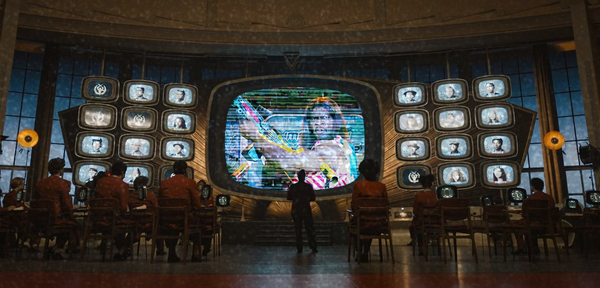
'We're Gonna Need a Bigger Backrooms': Archetypes, Masculinity, and the Maladaptive Hunt
The Backrooms (2026) has real script problems, but its concept is interesting enough to warrant some analysis. Using Frentz and Rushing's reading of Jaws as a framework, this post argues for Clark as Quint and discusses the film's inversion of the hunter myth's "sacred marriage."
Spoiler warning: this post contains numerous spoilers for The Backrooms. Also includes incidental spoilers for Jaws, the Southern Reach Trilogy (mostly Annihilation), Psycho, The Yellow Wallpaper, and assorted H. P. Lovecraft content.
In 1993, Thomas S. Frentz and Janice Hocker Rushing wrote an essay about Jaws (1975) to argue for rhetorical criticism to merge ideological criticism and the deployment of Jungian archetypes in such methods. Within this essay, they engaged with Richard Slotkin’s work on the myth of the hunter, who “leaves the confines of the tribal circle to hunt his animal or human prey” (p. 65) as part of a growth ritual. In the case of Jaws, the animal prey is aquatic, and thus connected to the “inward ocean” of the mind, meaning the human unconscious. Last week, I saw The Backrooms at my local theater and feel like positioning Clark (played by Chiwetel Ejiofor) as the hunter (as Frentz and Rushing did for Quint et al in Jaws) is appropriate. There are many parallels between Jaws and The Backrooms, and it’s worth taking a Jungian and psychoanalytic approach to the film, mostly for what the director ends up saying (or not saying?) about the human condition.
WTF are the Backrooms?
The Backrooms is a 2026 film directed by youthful director Kane Parsons, best known for his work on YouTube on the channel KanePixels. His world of Backrooms content builds on a substantial amount of community-driven lore about an area of the world accessible through no-clipping through reality, all derived from a 2019 post on 4chan featuring a 2002 photo of a former Wisconsin furniture store. In many ways, Kane’s content has ignited a real feeding frenzy of interest in Backrooms content since his first short film in 2022, which has expanded as a series of short films in the same timeline/universe.
The 2019 4chan post that started it all, shared to the /x/ Paranormal board, called for others to contribute other “disquieting images that just feel ‘off’”. In a reply about eight hours into the thread’s existence, another user posted this in reply:
If you're not careful and you noclip out of reality in the wrong areas, you'll end up in the Backrooms, where it's nothing but the stink of old moist carpet, the madness of mono-yellow, the endless background noise of fluorescent lights at maximum hum-buzz, and approximately six hundred million square miles of randomly segmented empty rooms to be trapped in
God save you if you hear something wandering around nearby, because it sure as hell has heard you
Thus, the term “Backrooms” was coined, alongside a vehicle of access (no-clipping, exploiting collision detection in video games), and the horror of something lurking amidst the labyrinthine rooms. In Kane’s first video, an amateur filmmaker falls while backing up for a wider angle of a goofy low-budget scene and finds himself in the Backrooms. He then wanders the yellow halls of this complex, his footsteps echoing eerily through space, before he is hunted by an unknown entity (later named the Life Form). Kane’s follow-up videos expand on the universe and add in hazmat suit-clad Async researchers. They are legitimately good YouTube content in fairly short segments, mostly generated in Blender.
Beyond Kane’s work on Backrooms content, a whole web of fan-generated content has exploded around Backrooms content, sometimes intersecting with the Secure-Contain-Protect/Special Containment Procedures (SCP) fan universe (of which I’m unsurprisingly a huge fan), and especially taking on the latter’s penchant for categorization. From this tendency, some Backrooms wikis profess a thousand levels of the Backrooms (the movie flickers through some to show that the deeper into the Backrooms one goes, the more chaotic and fragmented the complex’s memory becomes), but most focus on levels 0-8 (starting with the Lobby and ending with the Caves).
The horror of the geometry of the Backrooms plays a large part in why they make everyone so anxious. Just as H.P. Lovecraft played with non-Euclidean architecture (such as in “The Dreams in the Witch House” and At the Mountains of Madness), wherein the geometry of cosmic horror’s space violates human cognition in how it shouldn’t be able to exist. The same can be said for the Backrooms, which seem endless and randomly segmented. Similarly, the architecture as different elements of the human psyche is something that often appears in horror movies. Hitchcock’s Psycho uses the Bates house as Norman Bates’s skull, with the cellar as his unconscious and the parlor as his ego. Both Lovecraft pieces and Psycho use architecture to map mental states, but Lovecraft makes this unknowable while Hitchcock makes it readable. The Backrooms oscillates between these two, but usually leans more towards Lovecraft’s approach, given the heavy emphasis on the Backrooms as an unconscious “Complex” (more on this latter).
Kane’s The Backrooms lore differs from some of the earlier Backrooms lore in that null zones (where someone can clip into the Backrooms) can be returned through. These areas – like the invisible door in The Backrooms protagonist Clark’s sublevel – are deeply unstable but can stay open for hours, days, or extended periods of time. Most other Backrooms universes outside of this specific telling make it explicit that as soon as someone clips into the Backrooms, they can never leave (just as one is usually unable to return through the map in a video game after using a no-clip exploit).
The Un vs Sub
The movie conflates the subconscious and unconscious. The Backrooms, in the anxiety they produce over their nonsense, play with themes around the human unconscious. In Jungian terms (and as with Lovecraft’s impossible architecture), such an encounter with the unconscious may be understood through the metaphor of the nonsense architecture of the Backrooms. How Clark describes these rooms as an allegory for the habits and loops he has been on, however, aligns them with the subconscious. In many ways, the writer conflates the two, as most mass audiences would. This conflation, however, ends up making a lot of the possibility of a rich psychoanalytic work a bit more difficult because its coherence slips.
The connections to the Backrooms being about trauma and anxiety are heavy-handed in the script, as both Clark and Mary (portrayed by Renate Reinsve) have trauma over a failed marriage and a paranoia-ridden upbringing, respectively. Phil (portrayed by Mark Duplass), the Async staff member observing the Backrooms “Complex” – notably a polysemic term for both the sprawling architecture of the Backrooms and an identified structure in the unconscious connected to responses to a threat to the self – ran an MRI company to study brains, the physical faculties where the physiology of mental and neural disorders lies. The lexical condensation that polysemic and symbolic alignment around these details of The Backrooms is what Frentz and Rushing call “condensation,” whereby two different registers of meaning are pressed into the same symbol so tightly they become consubstantial. When the film names both the sprawling architecture and Clark’s psychological structure the “Complex,” they are squished together such that the two meanings are intertwined. There is likely a lot of analysis that can be wrought if we treat the Backrooms as only the unconscious, rather than the literal spaces accessible by multiple characters in The Backrooms. In my opinion, Kane shies away from this view because it doesn’t fit with his usual universe of the Backrooms, but he still tries to get away with making the references with heavy-handed symbolism, some of which I’ll untangle below.
Returning to Frentz and Rushing
As I mentioned at the start of this post, Frentz and Rushing grapple with the myth of the hunt. This myth contains several key parts, as described by Richard Slotkin in his work on the mythology of the American frontier. First, the (typically masculine) hunter departs from their tribe and enters the wild (typically as an initiation ritual). Notably, the wild is usually treated as a metaphor for the unconscious. In pursuit of his prey, the hunter is led toward water (the “inward ocean” of the mind, as the hunt doubles as a descent into the self). Within this descent, the hunter searches for his anima, Jung’s term for the obscured female element of the masculine psyche. In succeeding in this hunt, the hunter finds (in Slotkin’s terms) a “sacred marriage” with this feminine spirit of the wild, thereby transforming the hunter and sending him back to his community having achieved manhood, gained power, and earned new knowledge.
The hunter also has a counterpart in his tribal grouping, known as the shaman. The shaman gains insight through mind and spirit rather than conquest. This shaman sanctifies the hunt and keeps the hunter from his excesses. Without the shaman, the hunter is prone to hubris, and the “sacred marriage” becomes murder or exorcism as the hunter kills, dominates, and is bloodied with nothing learned. What Frentz and Rushing argue is that the American hunter myth, which is inextricably connected with whiteness, has become a domination ritual dressed up as initiation. In Jaws, they see the repressed anxieties of a dehumanizing economy merge with the archetypes of the Terrible Mother, such that the shark hunters are able to slay the feminine in the conquest of their economic anxieties.
Frentz and Rushing describe three different masculinities in Jaws. Quint is anti-systemic and wounded, much like Moby Dick's Captain Ahab. Hooper is privileged and therefore has the affordance to love the Other. Brody is an emasculated Everyman who gets initiated into the hunt. Among these masculinities, Clark is most directly Quint, and his wound is almost structurally identical to the Jaws character. Quint had his USS Indianapolis tattoo removed, but can’t erase his memory of the event; whereas Clark describes his architecture notebooks, but never opens them. His failed marriage and paused career are the indelible marks we keep hearing about from Clark, just as Quint’s erased tattoo proves his own inability to move beyond the harm of his past. The wound is proof of a haunted self, and both men hunt to avenge rather than heal.
Frentz and Rushing’s interest in Slotkin’s question – “What becomes of the new self, once the initiatory hunt is over?” – becomes salient to the plot of the movie. For Clark’s character, there is no ‘after’; the hunt is never ‘over’ because he becomes Captain Clark (his shadow self, literalizing what Jaws shows metaphorically) and chooses to sink with his metaphorical ship. His narcissistic withdrawal is an interruption in the arc of the hunt’s overall narrative, but doing so is aligned with the American perversion of the hunter myth.
Note: I don't delve into this in this essay, but I want to register some discomfort at white actor Robert Bobroczkyi playing Captain Clark, wearing prosthetics to appear as a warped version of Black actor Chiwetel Ejiofor. If not explicitly blackface, it seems troublingly close. This is especially true for a movie wherein it is not clear that Clark, as a character, 'knows he is Black' (evoking Tramell Tillman's question to Ben Stiller and Dan Erickson regarding his Severance character Seth Milchick). I also recognize the irony of this race-swapped character existing narratively as the protagonist's 'shadow' self.
In The Backrooms, Clark is both hunter and prey, collapsing the dichotomy that Frentz and Rushing provide. In the original myth of the hunt, the hunt is an initiation involving an encounter with the Other (the beast, the unconscious, the anima), and the hunter returns transformed. Clark’s hunt fails as he fails to defeat the prey, instead becoming it. In Vandermeer’s novel Annihilation, the first of his stellar Southern Reach trilogy, his protagonist, the biologist, is recreated in Area X as Ghost Bird. This space, like the Backrooms, mirrors those who enter it. However, while Clark’s Backrooms are described as his own loops and Captain Clark a horrifying perversion of himself, the Biologist’s copy (Ghost Bird) sits on the blade’s edge between horrifying and transcendent. While Vandermeer is a bit ambivalent about judgment on her copy, he portrays the biologist not sinking into herself to be destroyed but instead emphasizes that the biologist becomes something she could never have become when Ghost Bird emerges from Area X alone.
In the second act of The Backrooms, the therapy roleplay scene from the movie’s opening is repeated in a very Lynchian table scene. Clark has tied up Mary in a chair and three still life characters pose around the kitchen (the Bearded Man still life seated at the table, the Red-headed still life in the corner behind Clark, and Archibald Leland Sutter still life to Mary’s side). Clark confronts Mary in a reversal of the language of cognitive behavioral therapy, saying he is unwilling to change the loops and patterns he finds himself in. Clark himself, in this table scene laden with psychoanalytic fodder, shares his theory that the Backrooms are the modern world's subconscious. In this case, Captain Clark (the monster stalking the Backrooms and who killed Clark’s young, exploited staff several scenes prior) is Clark himself at his most monstrous. Namely, this version of Clark is everything degrading about his job as a budget furniture salesman (dressing up for cringy marketing spots) and painful about his closed dream of working as an architect (stumbling through rooms not of his own creation). Clark choosing not to change and turning inwards to inhabit the Backrooms is what psychoanalyst Melanie Klein would likely describe as narcissistic withdrawal. Her conceptualization of this process built upon Sigmund Freud’s theorizing on ego defense, the unconscious psychological process through which the individual protects oneself from the harm of both internal and external stressors. Change is hard, and succumbing to withdrawal (and indeed being literally consumed by a symbol for it) seems the easy way out for Clark, even if it literally destroys him.
The unconscious contains all the sexual anxieties that made Freud so famous. It is, therefore, fascinating to see – in this scene of confrontation – that Clark penetrates the Bearded Man still life with a knife and dresses Mary in the scalp of the Redheaded still life (borrowing from Hitchcock’s Psycho, perhaps). As he penetrates the Bearded Man, he looks to Mary and says, “Imagine how good that must feel!” At the same time as this Freudian engagement, Clark is also struggling with the ghosts of his own failures. He has clearly brought in the wife he is separated from (the Redheaded still life), and a distorted still life of himself (Captain Clark) roams the Backrooms, committing violence. It is unclear what the Bearded Man still life and Archibald Leland Sutter still life represent beyond the former’s complacency to be consumed (literally the stuffing ripped from him to feed Clark) and the latter’s aid in the dark (he has a lamp attached to his wheelchair that he turns on when light is needed). Perhaps these two men are Kane’s Hooper and Brody? I don’t yet have an answer.
Returning to Frentz and Rushing, the table scene inverts the “sacred marriage” stage of the hunt, wherein the masculine hunter achieves union with the feminine spirit of the wild. Clark psychotically forces a union upon Mary (through the symbols of Redheaded still life / Barbara’s scalped hair). Instead of this as a moment of revelation for the hunter, Clark instead transforms this into a symbolic act of murder or exorcism (as with the protagonists of Jaws). Mary occupies the paranoid/wild feminine position, the Red-headed still life is the domesticated wife, and Clark’s act of violence fuses the two when he places the Red-headed scalp on Mary’s head as a wig. The film doesn’t pretend that this masculine violence solves Clark’s wound, but the resolution is Clark’s destruction and his shadow self’s replacement of him within the action of the movie.
In The Yellow Wallpaper, the 1882 novel by Charlotte Perkins Gilman, the protagonist has a psychotic break as she withdraws into the pattern of the horribly colored walls. She eventually becomes the figure she is watching within the paper’s pattern as her husband, John (a physician) observes her and records her symptoms from a distance. In this story, just like The Backrooms, a space becomes territorialized as the unconscious, and I imagine the eponymous wallpaper is something like the color of the Backrooms themselves. Just as The Yellow Wallpaper’s protagonist withdraws into unreality and descends into her own madness, so, too, does Clark. Her escape isn’t into awareness, but instead, like Clark, she permanently resides within the unconscious as she is consumed by it.
Frentz and Rushing, and those who deal with archetypes and myth, would probably also look to Phil as a failure to meet the role of the shaman in the hunt narrative. We witness Phil’s inability to restrain Clark in order to help him deal with his excesses. All he can do is watch Clark, wordlessly, through cameras set around the Complex (a step further removed from The Yellow Wallpaper’s John). Without the shaman’s intervention (and sanctification), Clark’s excess therefore has nowhere to go but inward, leading to his withdrawal. Phil’s mode of knowing (brain scans and surveillance footage) is antithetical to the shaman’s role, and he can not earnestly enter Clark’s world to intervene.
The Failure(s) of the Economic Critique and Masculinity
Frentz and Rushing end their Jaws article with a moral assessment, which is also appropriate here. They contend that Jaws is about economic domination, unconscious disruption of the community, and late American masculinity’s newfound bloodied resolution through the hunt. Clark’s arc, however, goes in yet another direction on essentially every count, and it really seems like no one is positioned to learn anything through the action of this story.
Jaws offers a false resolution to its ideological problem, but The Backrooms takes the troubling narrative of Jaws and pushes further by offering aestheticized collapse. Clark’s withdrawal is a dark inevitability and the film doesn’t pretend that there was any other way for him to go. Everyone who could intervene (Mary and Phil) is powerless, and the still life figures are literally consumed by Clark. Masculine psychological collapse is never subjected to any real moral scrutiny in the film and it therefore naturalizes Clark’s eventual withdrawal.
There are elements of The Backrooms that get at an economic critique – the 90s particle board ‘no credit needed’ box store surge and crash as background to this movie – but they only serve as setting rather than as any real engine for plot or analysis. In Jaws, the class critique is nested within the archetypes of horror, which ultimately scapegoats the feminine for the crimes of capitalism (hardly a great outcome!). The Backrooms could have been more situated within this material reality, even as it directly spells out its Jungian machinery.
I will say, in wrapping up this long-winded Jungian post, I was underwhelmed by this movie. There are substantial issues with the writing, such that the dialogue is deeply messy, the symbolism is heavy-handed (Mary using the handprint totem from her childhood as a weapon to bash Captain Clark), and the plot struggles significantly at points. Clark’s descent into madness is swift and largely unearned in the way the script portrays it (and its troubling equating of the Backrooms with schizophrenia perhaps bears a whole other critical post). Mary’s reaction makes little sense, perhaps due to how little real characterization we get from her. The relationship between a patient (Clark) and his therapist (Mary) doesn’t do the plot much service, simply because the relationship is uninteresting – truly it only serves to provide tell-don’t-show exposition about character pasts without offering much meaningful insight regarding motivations.
The Backrooms had moments of greatness, like the set itself and the lead’s acting in key scenes like the table scene I talked about, but this movie shines in the concept rather than the execution. The movie feels like a third act is coming, and then it just ends, with a really unsatisfying (and honestly lazy) final scene that can only mean it is setting up for a series of movies. Given the director’s interest in this being a whole series of films and the massive box office showing, we very well may see The Backrooms as a series over the next decade or two. As I was writing this, Kane announced that a sequel is already in the works (and so, too, is a potential anthology collection). I suppose time will tell how this world is expanded, and Kane’s indication that he is seeking more help on the script is a good sign.
Thanks for reading! Consider reading my analysis of Severance and Squid Game, which is related to this post in some ways, here:
 hampton.