Severance and Squid Game: A Tale of Two Season Twos
Season two of Severance and Squid Game built on the anti-capitalist critique of their first seasons, but in vastly different directions. This post explores how they diverge.

Spoilers for seasons 1 + 2 of Severance and seasons 1-3 of Squid Game pervade this post. Read on only if you are okay with seeing direct and explicit spoilers of key story moments (including twists, finale reveals, and more).
Season 1 of Severance excelled because it was clean where it needed to be and messy where the lack of clarity drove mystery. When I watched season 2 over a year ago, the expansion of the show's budget was apparent, but the clunky story’s attempt to demystify some of the elements of season 1 dulled the edge of the show. Season 2 of Squid Game, on the other hand, took the foundations set by season 1 and exploded into one of the best second seasons of television I can recall.
I think a lot of this comes down to how American and Korean anti-capitalist art (exemplified here in the popular medium of serialized video content) differ in execution, meaning, and imagination. Some of this is the burden of culture for American mass media, and it may come down to American writers/directors worrying about being too radical. This fear doesn’t seem to come to Korean writers/directors, even as American neoliberalism still subsumes all radical media as something to consume. Fredric Jameson’s work on mass media is relevant in both directions: his theorizing of the tensions between parody and pastiche explains the set-up for both shows, but his theorization of reification explains season two of Severance (a dynamic that is notably less absent from season two of Squid Game).
Severance is an American show that premiered on AppleTV in 2022, with Ben Stiller directing and Adam Scott playing the main character, Mark Scout (Mark S. inside his office). Squid Game is a Korean show that premiered on Netflix in 2021, with Hwang Dong-hyuk directing and Lee Jung-jae playing the main character, Seong Gi-hun (Player 456 inside the games). Season two of Severance aired from January to March 2025, and season two/three (both are linked and were filmed back-to-back) of Squid Game aired from December 2024 until June 2025. Both shows are critiques of contemporary capitalism, though they make radically different claims about systems, people, and well-being. This difference becomes extremely apparent in the sequel seasons of these shows.
In Severance, the characters have gone through a process to split their consciousness into a work persona (an ‘innie’) and a leisure persona (an ‘outie’). Each persona has their own consciousness, memories, and interior life. In Squid Game, 456 poor people have volunteered to join a competition show for a pot of cash that grows as more contestants die, all while anonymous (international) wealthy benefactors watch the contestants fight, die, and win the games.
As Jameson argued in his 1991 book Postmodernism, or, the Cultural Logic of Late Capitalism, post-modernity marks a move from parody (or satire) towards pastiche. Parody, as Jameson wrote, implies social judgment, whereas pastiche is a (mis)using of history, culture, and icon that is often decontextualized from the object and thus devoid of any critique or argument. Satire, in how we routinely understand it, is usually only as good as its critique is apparent.
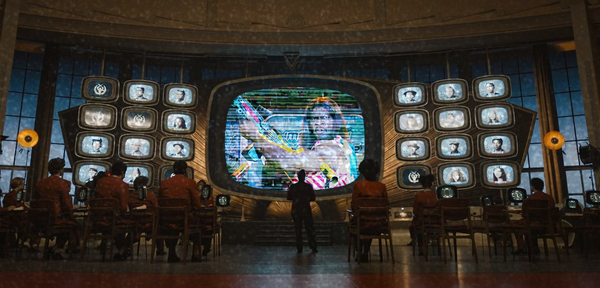
At their aesthetic cores, Severance and Squid Game showcase a satirical portrayal of something aesthetically well-known: corporate work on the former and children’s games on the latter. Not everyone has experienced white-collar, cubicle-ridden work and the endless memos, computer-facilitated tedium, and awkward work relationships these carry, but they are iconic in American culture. And while the schoolyard games of Squid Game are mixed through their references outside of Korea (few likely know the eponymous game), others are familiar to Western audiences, like red light-green light, tug-of-war, and rock-paper-scissors. The set designs and costumes of both shows carry their aesthetics forward: Adam Scott’s Severance character works for Lumon, known for its 70s corporate-chic design and the tie-laden staff, while Lee Jung-jae’s Squid Game character faces the bright, saturated colors of playgrounds and green tracksuits of the games.
Severance and Squid Game both use these visuals to subvert expectations by juxtaposing them against known images of violence. In Severance, Helly awakens to find herself laid out on a conference room table like a human sacrifice on an altar or corpse on a morgue slab. Young-hee, the giant doll of Squid Game, uses a cutesy voice to exclaim ‘red light!’ before snipers mass murder game participants caught moving.
Severance
One of the important elements of the bullshit work of Severance, as portrayed through protagonist Mark Scout’s role in Macrodata Refinement (MDR), is sorting computer data into on-screen boxes. These digital containers are labeled WO, FC, DR, and MA. These codes, we learn, map onto one of the many theories and maxims of Lumon Industries founder, Kier Eagan. Kier’s life philosophies (or work philosophies? or work-as-life philosophies?) make their way throughout the show, often through references to the employee handbook, John Turturro’s character Irving Bailiff quoting him, or the company’s eerie Perpetuity Wing wax museum. One of Kier’s most important works describes his theory of taming the “four tempers” of the human soul: Woe (WO), Frolic (FC), Dread (DR), and Malice (MA). These tempers are clearly modeled off of Hippocrates’s four humors (blood, yellow bile, black bile, and phlegm), but moved from physiological health towards psychosocial health. This perhaps marks a key signpost for the show’s engagement with American postmodernity placing more emphasis on knowledge and analysis work (e.g. that which is done in an office) versus the physical labor of the past (or of the outsiders or the dispossessed).
Severance's second season doesn't abandon its critique so much as dilute it. It spreads its symbolism across too many registers until none of them really land. To this end, the MDR crew is revealed to have been taming the tempers of different personalities of Gemma Scout, Mark’s wife, who has been kept as a captive test subject on her own designated floor. Rather than doing bullshit work for a megacorporation, they are engaging in work to advance Lumon’s development of severance chips. There is a horror in the realization that the severed staff members are working to further their own techno-subjugation, and it becomes apparent that their whole role at work may likely just be to test the process of severance. Gemma is, therefore, revealed as a literal hostage of Lumon, moving from the nominally voluntary participation in bullshit labor into the directly compelled and brutally violent life of dental procedures without anesthesia and mourning of a devastating lost pregnancy.
Kier Eagan’s presence in the show transforms from the haunting mythos of a deceased founder of industry – akin to Henry Ford, Steve Jobs, or John D. Rockefeller – towards one of explicit religious mythology through the story of Woe’s Hollow. In this story, exemplified in season two’s episode of the same name, Kier’s twin brother, Dieter, melts through divine intervention after he masturbates. Fleeing the sounds of Dieter's deconstruction, Kier encounters the corpse bride of Woe. His founder mythos becomes literally supernatural, breaking the bounds of similarity to these other men (Ford, Jobs, Rockefeller).
In Aldous Huxley’s 1932 novel Brave New World, Henry Ford plays a similar role to Kier in Severance. His worship is a secular religion known as Fordism, but Huxley keeps this connected to technological utopianism rather than the supernatural. Huxley's constraint helps Ford's presence land as critique where Kier's begins to fall apart. If Lumon is Apple/Microsoft/Amazon/Tesla, none of their founders needed the literal force of the divine to craft a great man mythos. Kier reads like a plausible composite of these men up until the show makes him a cultic figure rather than one with a cult following, and thereby the critique loses its legibility. Jameson would have recognized this move as the aestheticization of the satire, and once a critique becomes primarily a visual experience, it usually stops being a critique. A cult following still sees its object as human, whereas a cultic figure gets lifted out of historicity entirely. Moving Kier into this latter category removes him from the reference points of late capitalism, thus dulling the critique offered in Severance's set-up. In Jameson's terms, the show slips towards pastiche, maintaining the iconography of founder mythology, but without the critical distance that made it mean something.
Eagan’s ideology becomes contested by the discovery of The You You Are, a common-sense aphorisms-laden book by Mark’s dopey self-help guru brother-in-law, Dr. Ricken Lazlo Hale. Innie Mark S and his coworker Dylan G (played by Zach Cherry) end up treating this vacuous text as a manifesto that encourages them towards workers' revolt, replacing the hollow maxims of Kier with the shallow ones from Ricken. This is a really strong story point, as it shows that the workers’ ascertaining a revolutionary vocabulary helps them supplant the corporate mandates of Lumon Industries. It serves as a sort of Communist Manifesto stand-in, but is parodic in how little it actually says, whereas such revolutionary texts of the past are often deeply cutting.
Season two starts with a really interesting interrogation of corporate control as Seth Milchick (portrayed by Tramell Tillman) moves towards a softer corporate environment of incentivized compulsion rather than the psychological torture of the previous regime. In episode three of this season, Milchick is presented with “re-canonicalized” portraits of Kier, where the founder is repainted as a Black man as an ‘inclusivity’ measure to honor Milchick’s ascendance. Milchick and seemingly-biracial Natalie Kalen (played by Sydney Cole Alexander) share a knowing look as the white corporation tries to appeal to Black managers through a pretty tasteless move, with Natalie saying she also received the same gift. This soon fades as the bulk of season two moves away from talking about work and the economy and towards the human condition (in a way that is largely removed from what could be called the conversation of politics).
Season two of Severance moves away from the workplace critique of season one, instead focusing on themes that are more linked to the questions of metaphysics and philosophy: Does individual autonomy exist? Where is identity located? How do humans build meaning? While these are interesting questions, I think they supremely miss what was so intriguing about the themes of the first season of Severance.
Squid Game
While season two of Severance moves away from its target (corporate hell), Squid Game season two intensifies its anti-elite themes. While Severance starts pondering personhood, season two of Squid Game literally involves an armed uprising against the masters of the games.
Season two begins where season one ended: with protagonist Seong Gi-hun committed to ending the games he just won. He eventually joins another round of the games, with the intention of organizing the contestants (read: dispossessed workers) in destroying the games. This eventually leads to Gi-hun organizing a literal armed rebellion alongside Cho Hyun-ju (a former special forces sergeant seeking funds to complete her gender-affirming surgery, played by Park Sung-hoon) and several others of varying tactical/combat prowess.
Squid Game's decision to make participation a choice, not just before the games but through an ongoing voting mechanic each round, is what separates it politically from the conscription-based death game Suzanne Collins established in The Hunger Games. In Collins's world, children are yanked from the families of the production districts of Panem and fight to the death in an arena created by a committee of sadistic weirdos led by a game master. These games, which happen every year, draw at random the name of a boy and a girl from each district, though the number of times someone's name is in the pot (and thus their likelihood of being pulled) increases both as the child grows older and as the child's family requests welfare from the state. Therefore, the people most likely to have their name pulled from the pot of names are those who are older, sure, but mostly are those from families whose needs are most dire. The Hunger Games, originally intended as a punishment for the districts' failed revolution of generations ago but developed into a spectator mega-event akin to the Super Bowl, Olympics, or World Cup, therefore selects for the poorest and most needy from each district (or at least puts its thumb on the scale to tip towards this direction).
I love The Hunger Games, and it is certainly a series about dispossession, oppression, and alienation, but I think Squid Game's decision to make participation in the games a 'choice' makes it even more relevant to contemporary scenarios. These are deeply desperate people, and a fifth of one percent of them will survive the games (most will die without the show even giving them an opportunity for character development). It's the lottery, but with directly lethal consequences (through physical violence, though IRL this violence would be structural). The violent compulsion of The Hunger Games leads to rebellion, but Squid Game's coerced consent through first-past-the-post voting keeps the games continuing. The VIPs and organizers of the games permit the voting as a spectacle, knowing that the games will almost certainly continue regardless. Squid Game is landing some heavy blows here, describing how ideology reproduces itself, often through maintenance of a system that's killing them simply because the alternatives are made impossible by looming debt, desperation, and the structure of choice under capitalism.
In season 2/3 of Squid Game, Gi-hun's revolution definitionally fails, but symbolically succeeds by making the organizers of the game bleed, perhaps for the first time. Gi-hun and his comrades sacrifice much for the rebellion, and the Front Man (played by Lee Byung-hun) executes Gi-hun’s longtime friend Park Jung-bae (played by Lee Seo-hwan) in front of him at the rebellion’s peak. Gi-hun makes it to the end of the games after they resume, but sacrifices himself to save an infant born during the games by a since-deceased contestant. His final season's martyrdom completes the cycle as to why Gi-hun rejoined the games, as he sought to send a message in refusing to become another Front Man.
The Front Man, as it turns out, was a previous winner of the games. In winning these lethal games, he was offered the ability to transform from a victim of the system to an enforcer of violence to maintain it. Just as late capitalism can occasionally select a victor from among the poor, dispossessed, or wage-bound, the same happens within the microcosm that is the games. It is extremely salient, then, that this victor becomes the cutting edge of enforcing the system, operating as its most stalwart defender. Front Man is Jameson's perfect figure of reified capitalism, someone who survived the full violence of the system and whose ascendance from below is then absorbed into maintaining the system's order. Gi-hun’s final sacrifice is a message directed at Front Man, who solemnly delivers Gi-hun’s bloody jacket and a prize card to his daughter. Later, in Los Angeles, Front Man observes a recruiter for the games (played by Cate Blanchett) slapping a guy who just lost a round of ddakji (the paper-flipping game that was used to recruit poor people from subway stations in Seoul). After Gi-hun’s death, both of these scenes show Front Man processing his role, seeming to have begun to feel regret over his actions, yet continuing to keep the games going. It’s a poignant arc for this character.
Comparing the Sophomore Seasons
Both shows begin critically. Jameson would ask whether either holds this line into their second season. Severance doesn't, as it retreats into metaphysics, enacting the very reification it started by exposing. Squid Game does, which makes its commercial fate the more interesting problem.
There is something deeply ironic in Squid Game coming out of the Netflix machine, but that irony is explained through Jameson’s theorization. Late capitalism subsumes radical critique through pastiche by stripping the referent and selling the aesthetic back as product. Through Funko Pops, the Netflix reality spin-off, the Call of Duty skins Squid Game's critique gets decontextualized and sold back to the same audience it was critiquing. This doesn’t mean that Squid Game was invalid, but it shows its cultural impact such that capital interests have sought to reify the current economic configuration through commodification of the critique.
American prestige TV, however, has to serve multiple masters, which likely led to the production hell of season two of Severance at AppleTV. Philosophy is safer than labor politics in this sense. On the other hand, South Korea’s post-US occupation economy is a sort of hypercapitalism, with Gangnam in Seoul coming to represent the excesses of the neoliberal consumer society. So many different works of cultural and economic critique are coming out of Korea these days and finding audience among select critics and viewers in the West: Parasite won Best Picture in 2020 and Squid Game’s Lee Byung-hun (Front Man) just starred in No Other Choice this past year, for which he was nominated for best actor across several awards. It's deeply relevant, perhaps, that in 1997 the South Korean government accepted an austerity package from the IMF that dismantled labor protections and produced the mass precarity to which films like Parasite and shows like Squid Game are still responding. Hwang has cited the 2009 SsangYong layoffs as the show's political backdrop and his personal inspiration came from his own debt and unemployment during the 2008 global downturn, so he has drawn these lines for us.
Conclusion: Against the Slow Fade
What Severance and Squid Game ultimately demonstrate in their sequel seasons is that anti-capitalist critique is fragile because the systems that distribute them have every incentive to dull the most cutting critiques. Severance retreated from the sharpest version of itself into safer television. Its second season is well-made and beautifully shot but, while the questions it asks about consciousness and identity are real questions, they are questions that can be answered without changing anything about the (/our) world that produced Lumon Industries. Squid Game, on the other hand, stays materially angry and it doesn't let the mechanics of entertainment off the hook.
Jameson's whole point is that late capitalism is an absorptive system that can turn any critique into a commodity, sell it back to you as content, and leave the underlying structure untouched. Squid Game has had massive commercial success, yet it keeps a brutal critique at the center of the story. Severance, by contrast, gave a diagnosis and then asked us to feel something more manageable. The audience is called to wonder at the mystery of the machine rather than anger at the alienation produced by the machine, one that in turn mirrors the machinery of our own world. One of these shows got safer while the other got angrier, and it's worth thinking about why that divergence happened. Jameson might have argued that the difference doesn't matter, saying that both are products of the same machine. However, one of them at least had the nerve to take its stand out loud, in every episode, until the last.