UFC on the Lawn: Bread and Circuses without the Bread During Trump 2

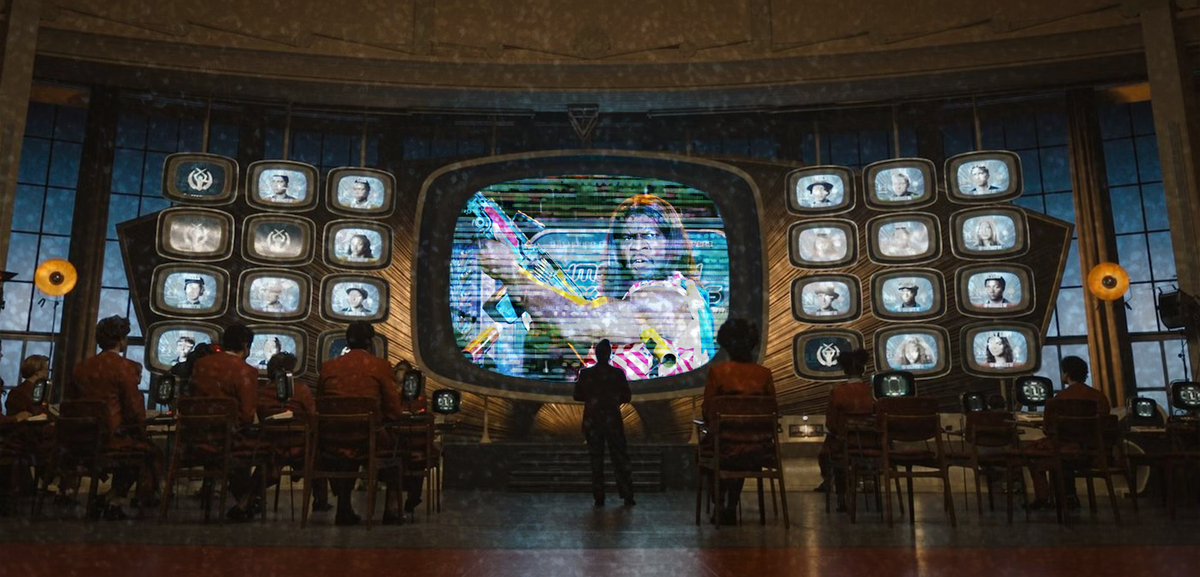
“Shit. I know shit’s bad right now with all that starving bullshit, and the dust storms, and we’re running out of French fries and burrito coverings, but I got a solution” - Dwayne Elizondo Mountain Dew Herbert Camacho in Idiocracy (2006)
We’re nearing the 250th anniversary of the signing of the Declaration of Independence and, relatedly, also nearing two decades since the release of Mike Judge’s cult favorite film Idiocracy. In a great merging between Trump’s birthday, “Flag Day”, and a lengthened July 4th celebration, the White House has been orchestrating a massive period of patriotic entertainment in DC. These include a UFC match on the White House South Lawn on Trump’s birthday, an Indy race around the Mall, and our favorite Hunger Games spin-off, the so-called Patriot Games.
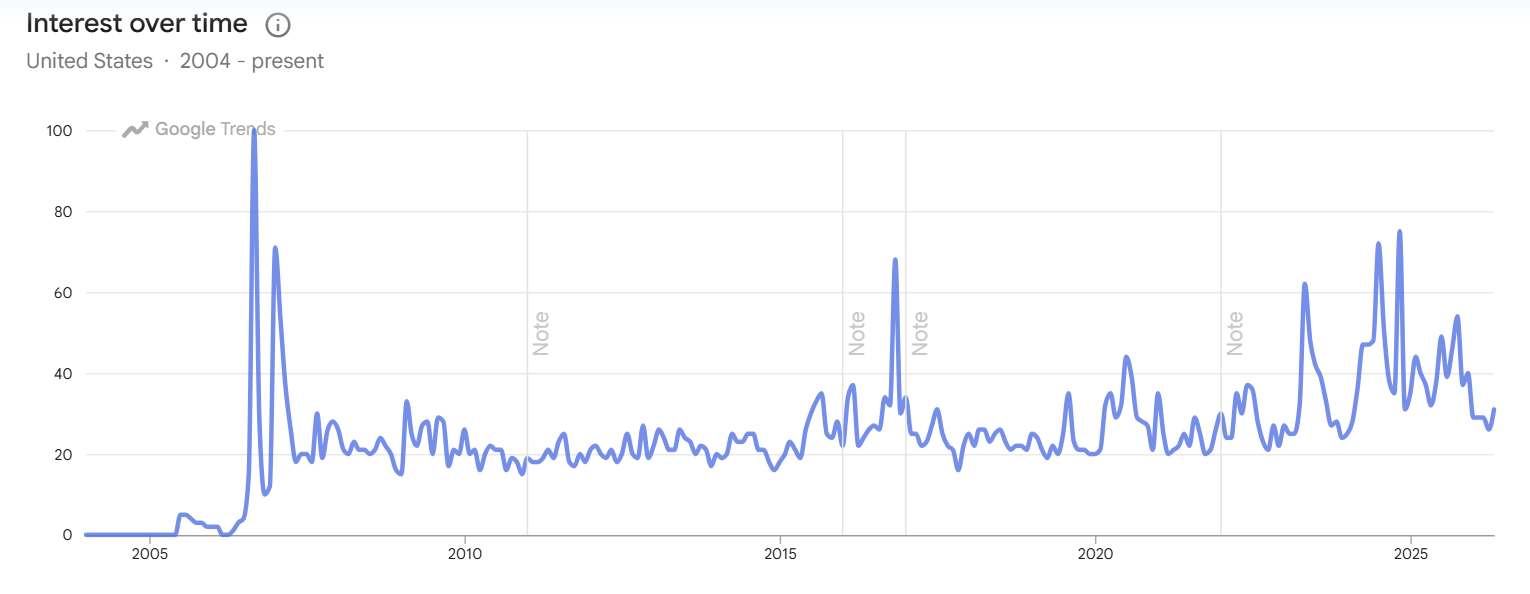
Idiocracy, a film I will focus on in this post, is a deeply imperfect movie, especially as it conceptually carries a fundamentally eugenicist view regarding birthrates, IQs, and the working class. The rise of Trump a decade ago has caused a resurgence in discussions of the movie, just as his second term has similarly led to another boost. This is evident in the Google Trends data (see below), where searches for the movie spiked in November 2016 after he was first elected (and has remained heightened throughout his second term).
I think there’s an almost reflexive liberal response to scoff at a spectacle like the UFC lawn tournament by saying “we’re living in Idiocracy” or “that movie was a documentary.” There’s an implied criticism here that this is because the public is deeply degraded due to societal rot (Idiocracy blames the reproductively-fertile proletariat while lamenting family planning choices of the intellectual middle class). This “Idiocracy as documentary” narrative analytically positions President Dwayne Elizondo Mountain Dew Herbert Camacho (played by Terry Crews) as Trump, an idiot elevated by idiots in a society that values rhetorical swagger and showmanship over policy. Idiocracy is, however, more a story about capital capturing the state, science, and rhetoric of society and leading it towards its ends. I’ll argue here that the elements of Idiocracy that are relevant are about corporate capture, not Americans’ breeding patterns, and that this is also a point of this movie that is missed in the general discourse.
In Idiocracy, President Camacho, who oscillates between direct antagonism and support towards the protagonist, does three key things that diverge somewhat from Trump’s approach. During a crisis, he defers to Joe as the smartest man alive, though places Joe under threat of state retribution if he fails. As I indicated in my epigraph, Camacho also names the problem he is facing rather than denying it. Lastly, he goes to the public with key updates to his policy, including when the variables change (Trump, in part, does this but often the updates are contradictory to the previous day’s or hour’s updates – see the war on Iran, for example). In the film’s resolution, when Joe’s policy is vindicated, Camacho intervenes to protect Joe after the economy collapses due to shrinking stock value of Brawndo (a sports drink that has replaced water everywhere, including for irrigating crops). There is a humility in this parody character, a clearly moronic president governing a dysfunctional regime of corruption, even as he spouts marketing slogans (“It’s got what plants crave!”) as policy.
The spectacle of the 250 celebrations, as an analogy for the rise of Trump, is not representative of a bottom-up degradation but instead is an extremely expensive project engineered by political elites. The UFC CEO, Dana White (a long-time Trump supporter and attendee at the April assassination attempt of the president, which he said was “fucking awesome”), has put $60 million into the lawn fight. Ivanka Trump is apparently involved in planning the event and the event required a laundry list of assessments and sign-offs from the federal government. The working class, even those who support Trump, have had very little role in creating demand for this event, which is being bankrolled by his corporate supporters and staged as an appeal to our “Emperor’s New Clothes” moment.
Members of the military who have been offered tickets to attend the fight will only receive their tickets if they meet military body composition standards. The audience for this event will have literal screenings by body type to spectate from the lawn. This is the opposite direction of Idiocracy, leaning towards an aesthetic of the idealized national body, something like what Susan Jeffords explores in her 1994 book, Hard Bodies, through her examination of Reagan-area film (an aesthetic often associated with Trump). In her 1975 essay “Fascinating Fascism,” Susan Sontag describes how fascist art puts forward a utopian aesthetic that includes physical perfection. She focuses on Nazi film-maker Leni Riefenstahl’s work and especially the director’s mid-century rehabilitation into the film canon. Riefenstahl’s film for the 1936 Berlin Olympics, Olympia, detailed a state-supported spectacle organized around the physical perfection of the athletes, which feels familiar both for the UFC fights and the upcoming so-called Patriot Games.
Next month, these Patriot Games will include one male and one female teen from each state, who will then be paired with celebrity coaches. The Freedom 250 website says that these athletes are meant to “light the torch for a new generation of Americans.” Trump is a reality TV showman and the marks of this past are clear upon this production, but it also feels obviously connected to The Hunger Games. It, therefore, awkwardly positions the Trump administration as the antagonistic government of Panem hosting competitors (tributes) from the states (districts) with celebrity coaches (mentors). A key difference here is that in The Hunger Games, tributes are typically involuntary and only the tributes from the capital districts are in it for the glory as athletes. My title here evokes the “bread and circuses” figure of speech regarding the (superficial) satiating of key mass desires (food and entertainment) to hinder any revolutionary spirit. This phrase is often attributed to the Roman poet Juvenal, who used the phrase “panem et circenses” in an early CE text. You may immediately notice that the Latin word for bread, “panem,” is also the name of the setting of The Hunger Games. This is an intentional connection that author Suzanne Collins made as part of her social commentary on early 21st century America (a similar context that Mike Judge is responding to in creating Idiocracy).
My argument is that these Patriot Games are similar to the Hunger Games in that they are a spectacle (read: circuses) while the United States is going through a volatile economic moment (read: no bread). This is evident through the federal government’s clear decision to cut back programs that would provide the placating bread of Juvenal’s argument, especially in the wake of DOGE. To their credit (begrudgingly), Democrats like Gavin Newsom have made the Hunger Games comparison, but their critique stays at the surface-level, looking solely at the function of the games rather than at the society that produces it.
The production cost for UFC on the lawn is over $60 million and replacing the lawn afterward will cost $700,000. Meanwhile, Trump’s bizarre tariffs have acted as a regressive tax on consumers, healthcare premiums continue to rise unchecked, and consumer debt is maybe the worst it has ever been. More than half of the cost of tariffs (which totals at a rate of about 12% by January 2026) passes through consumers, creating a new regressive tax adorned in the robes of economic nationalism.The Congressional Budget Office estimates that public debt will rise to 120% of GDP by 2036, the highest it has ever been. Nearly 500 port-a-potties will line the White House lawn for the UFC event but the aging sewer infrastructure for many states in the US are in need of urgent repair. Economic growth seems deeply tied to an AI bubble, despite the deep unpopularity of data centers and AI slop. The veneer over our economy that obscures just how much gambling and scamming has held it up has thinned, most notably through how ubiquitous betting apps and sites have become. These dynamics feel very similar to Camacho’s US, which is dominated by Brawndo’s marketing while the crops die, so long as the loyal and the elite have somewhere nice to watch Ow My Balls! UFC.
The 250th anniversary is a nominal celebration of a founding moment whose promises are increasingly spectral. Many of the founders would face vitriol from the leaders of the American right for the founders’ religious beliefs. The founders also held a strong stance against empowering an executive branch that would lead to recreating a monarchy, a principle that seems to be an abject failure as the sitting president plans a golden ballroom and is building a victory monument created in reference to imperial Roman and Napoleonic models. A (now-dismissed) lawsuit against the UFC event aptly calls it "a private, commercial, corrupt use of our most sacred national monuments for private gain.” In a neoliberal move that is still unclear on the status of its permanence, public space has become privatized and the spectacle is funded by an oligarch as a gift to his patron. We the people aren’t necessarily getting more like the complacent masses of Idiocracy, but the institutions seem to be hollowing out in ways that would make Brawndo executives blush.
Thanks for reading! If you're interested in this post, you might also like my essay on the Iran military campaign as idiot plot:
 hampton.