Keeping Up With The Neighbors: Firemen, Book-Banning, and Content Enjoyers
I have been attending a Banned Books Book Club for the last few years, which I initially joined as part of a New Year's resolution to find a book club and stick with it (I have since gone to a dozen different book clubs and have regularly attended the meetings for three since my resolution). This past month, we read Ray Bradbury’s Fahrenheit 451, which I had last read in middle school and hadn’t touched in the years since despite making my way through most of the rest of Bradbury’s catalog.
At one point, one of the booksellers in the club remarked that since 2024’s election, dystopian fiction sales had plummeted, as had nonfiction sales. The book club group speculated about whether this was due to the need for escapist fiction, but a younger reader said they specifically sought out thought-provoking and difficult texts. Anecdotes aren’t data, though, and it appears there’s something very different happening in Trump 2 versus Trump 1 when it comes to political texts and dystopian novels. As Ben Popken reported back in 2018, political book sales skyrocketed after Trump’s first election win; whereas after Trump’s second election, we are now in a slump of such consumption. There’s something haunting about reading one of the quintessential books about book banning (which I actually really appreciated returning to despite many of my compatriots having deeply mixed views on the text) while also reflecting on a similar societal moment. Barnes & Noble CEO James Daunt responded last month to the perennial complaint that “people don’t read,” saying it isn’t true, though his examples of what sells well is going to cause me to walk into water with rocks in my pocket (“Put Taylor Swift on a front cover — we're going to sell lots of those"). I’m ultimately not weighing in on that debate itself, but there are legitimate (and worrying) statistics that indicate we are already in a sort of post-reader society. These include the National Assessment of Educational Progress (NAEP) reading-rate figures that everyone cites: in 2024, less than a third of fourth graders were deemed proficient readers.
Despite the images of book burning being the most salient ones from Fahrenheit 451, the book banning policy in the text happened more through the way that liberal markets work -- society got less interested in reading as they shifted to a visual (mediated) culture and members of this society stopped reading such that they felt no need to keep challenging books around. I think you can see what I’m getting at regarding how eerie this meeting was for me.
Beatty’s Provocations
In Fahrenheit, our protagonist Guy Montag reports to a gruff supervisor, Captain Beatty, who is a complex antagonist for mid-century fiction (especially given that Playboy serialized the finished novel across three issues in 1954). Beatty is clearly well-read and maintains an extremely vast knowledge of literature, yet has come to act as one of the most fervent opponents of books (he says “a book is a loaded gun in the house next door”).
Beatty makes a speech to Montag, with Guy’s wife also present (she is dreadfully underwritten but still plays a crucial part in the story). It is a deeply expository moment in the fiction, which some would likely deride as telling not showing, but it gives some words to things I have been thinking about a lot recently. Beatty tells Montag that the firemen (those who burn books) came about after photography had reached mass audiences and started to provide motion pictures and television content to the masses. Due to this development, information “became simpler.” He continues:
"Picture it. Nineteenth-century man with his horses, dogs, carts, slow motion. Then, in the twentieth century, speed up your camera. Books cut shorter. Condensations. Digests. Tabloids. Everything boils down to the gag, the snap ending…
“Classics cut to fit fifteen-minute radio shows, then cut again to fill a two-minute book column, winding up at last as a ten- or twelve-line dictionary resume…. Hamlet was a one-page digest in a book that claimed: now at least you can read all the classics; keep up with your neighbors. Do you see? Out of the nursery into the college and back to the nursery; there's your intellectual pattern for the past five centuries or more.”
He then adds about the speed of information, too, saying:
"Speed up the film, Montag, quick. Click? Pic, Look, Eye, Now, Flick, Here, There, Swift, Pace, Up, Down, In, Out, Why, How, Who, What, Where, Eh? Uh! Bang! Smack! Wallop, Bing, Bong, Boom! Digest-digests, digest-digest-digests. Politics? One column, two sentences, a headline! Then, in mid-air, all vanishes! Whirl man's mind around about so fast under the pumping hands of publishers, exploiters, broadcasters, that the centrifuge flings off all unnecessary, time-wasting thought!"
I immediately thought about the almost meme quality of the hustle culture bro saying he doesn’t need to read books anymore because AI can summarize a bajillion books for him in the matter of minutes. There have long been summaries available for great literature, be they SparkNotes or CliffNotes or even some of the early YouTube Literary Criticism work (one of my favorites over a decade ago in an earlier era of online content was Thug Notes), but the valence of “give me a 5-sentence summary” is very different versus a chapter-by-chapter summary and character analysis sections of another medium.
As I am in a PhD program now, where I’m expected to consume, interpret, and mentally file away literally hundreds or thousands of pages of dense reading every week, I can surely see the market forces that drive this reflex towards shortening towards digest-digest-digests. Higher education, the so-proclaimed standard of intellectual development, has set up metrics for success that often aren’t tied to one’s scholarly development so much as our ability to participate in a seminar discussion or paper presentation. As such, schools have really struggled to battle against the sheer volume of looks-good-enough-but-is-empty content that generative AI tools can help an unmotivated student check all the boxes. These problems go much deeper than just my hand-wringing over the state of higher education, of course, but instead connect to the positioning of college solely as a vehicle towards getting a better job (and therefore framed under ‘return on investment’ type language). I am a student of the humanities, who sought out education not simply for its ability to connect me to the profession I want to be in, but to how it helps me develop as an intellectual and citizen, so this is a bit of a black pill.
Beatty’s digest-of-a-digest-of-a-digest is certainly something we’re anxious over regarding LLM summaries, and it's connected to both the grind culture and the rampant gamification of reading, where one’s value as a reader is often derived from how many books and how many difficult books one can read. The second book that we read at my work book club back in October 2024 was The Cat Who Saved Books by Sosuke Natsukawa (translated from Japanese by Louise Heal Kawai). It has a series of alternate-universe style stories about the different follies of reading, and in one chapter a man with a massive series of book shelves full of books tells protagonist Rintaro,
“All the intellectual leaders of our time, such as myself, are constantly reading. It’s vital for us always to be brushing up on our philosophy and expanding our knowledge. Books have made me the man I am today. They’re my dear companions.” (33)
Another scholar they visit is busy trimming down books to their elemental level, and tells Rintaro,
“These days… a book isn’t considered worthy just because it’s profound or difficult. People want to enjoy masterpieces in an uncomplicated way, pleasurably, fashionably, as if they were a downloadable collection of Christmas songs. A masterpiece cannot survive if it doesn’t adapt to the demands of the times. And so, I wield these scissors to sustain the life of such books.” (80)
And here, across two instances of Sosuke Natsukawa’s book, we find two of the key arguments that connect almost directly to what Beatty says in his expository speech I quoted earlier. There is both a cosmopolitan’s drive to appear fashionably aware and also a hoarder’s approach to maintaining this knowledge that drives the reader-intellectual as a social creature, both of which are derived from a deep suspicion of other humans. Higher education, seemingly the institution built to reward deep reading, cannot even avoid rewarding the performance of reading in the way it is structured today.
Beatty’s description of how the firemen came into existence places them essentially as a service industry. Rather than deal with this bifurcated society of those who read versus those who don’t, the public wanted to stop being bored, offended, or put down by those who knew more than them. The state apparatus (in the form of the firemen) came to manage this want. As a partisan on the side of a more well-read society, I obviously oppose this reflex, but I do recognize how and why it arises. I think looking at what drives both bookbanners and those who take an anti-critical stance online can help illuminate how this functions.
Inside the Minds of Bookbanners and the Folly of ‘Letting People Enjoy Things’
Emily Knox has literally written the book on how book banners think. She contends that challengers to books operate on a “common sense” interpretive frame, whereby they see a single correct and transparent reading of a text. For banners, there is no nuance and no room for criticism or deeper analysis. This is also downstream of what Cathy Davidson calls “undisciplined imagination,” the inability to hold a distance between a text and one’s response to it. One of the booksellers at my banned book club insightfully told the group as we read A Court of Thorns and Roses (terrible book, by the way) that adults ban fiction because of what it elicits in them. This is essentially Davidson’s insight, and one he mentioned when connecting ACOTAR to The Clan of the Cave Bear when he read it as an adolescent. Book banners have a theory of reading, such that they believe that texts act upon their readers and exposure leads to transformation. There is a reason that many of the banners’ targets are queer and racial justice-related stories, and perhaps there is some reality to their fears that the right books can be transformative for the right readers at the right time. This isn’t me justifying their actions, but it’s worth understanding their theory of engagement in order to respond to it.
Kate Wagner, writing for The Baffler in one of my favorite essays in recent publishing, describes our anti-criticism moment several points. The one that is most relevant to this essay, however, is her argument against the anti-critical turn as being one about exposure to critique: if I absorb any criticism about the things I consume, it will magically ruin my enjoyment of them. This is undisciplined imagination in the ways that Knox’s subjects also refuse perspectives.
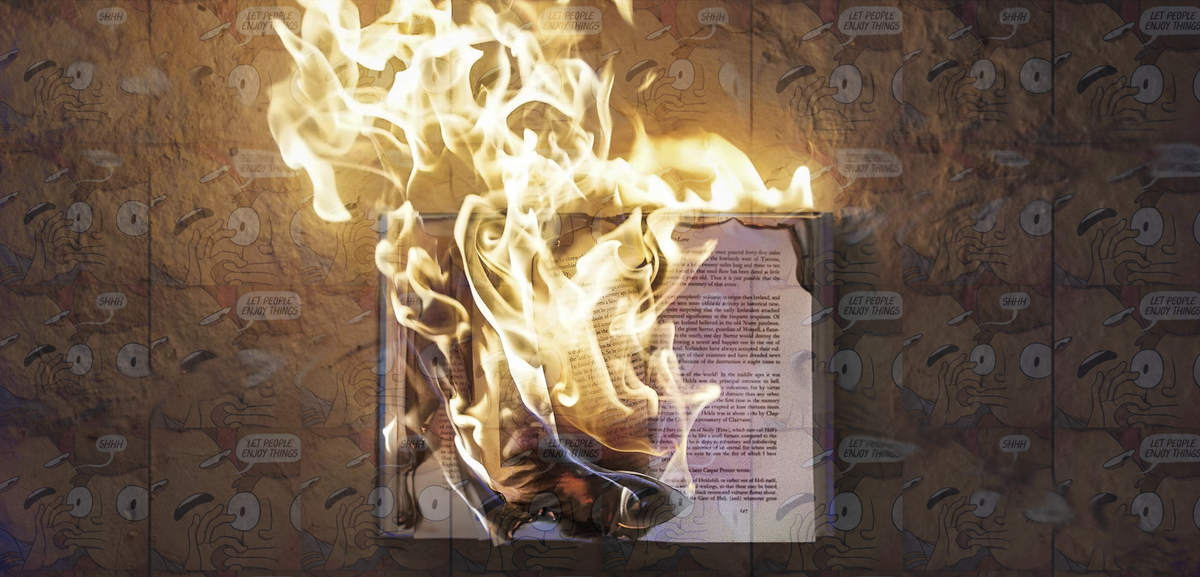
The bookbanner and the person hollering to ‘Let People Enjoy Things’ (LPET) have much in common, namely their viewpoint that reading critically is a hostile act. Microvideo, the format that has truly taken over much of our digital diet (if not the majority of anything consumed by most people these days), is saturated with argument and deliberate aesthetic constructions. We are told instead to receive this content (like the visual/video world of Montag and Beatty) as pure sensation. The bookbanner at least concedes that books do something, whereas the LPET people deny that books do anything at all: seeking to ban a book is a backhanded compliment to the act of reading itself as something transformative.
There are good faith cases for LPET, of course, and I think here of Rita Felski’s lamentation that so much of literary studies relies upon a hermeneutics of suspicion. But Felski is arguing not for less attention on the material (as LPET, bookbanners, and firemen might argue) but instead for an opening up of criticism; an expanded vocabulary of litcrit. Adam Waters and E.J. Dionne Jr also waded in on this subject in Dissent, arguing whether anti-intellectualism (the common thread between the subjects this whole blog post is about) could occasionally be good for democracy. Waters and Dionne, however, conclude that anti-intellectualism is a symptom of intellectuals abandoning any obligation to ordinary people’s lives. The interpretive class, as they argue, made themselves easy to resent, and Felski’s identification that a lot of literary studies takes an approach of the negative only intensifies this (who likes a downer, after all?).
Concluding with Unlikely Watchdogs
In starting this essay, I mentioned the younger members of my book club seeking out difficult texts (thus pushing back against the escapism theory), and there’s a connection to Bradbury across time on this, too. Bradbury’s publisher, Ballantine, quietly censored Fahrenheit 451 by creating an amended version for schools in 1967. They altered around 75 passages, ultimately changing a lot of the tone of the book.
One might think that censorship watchdogs or the author himself would have been the ones to have caught Ballantine’s mischief, but it was actually students seeking out his text to read. After discovering the edited text, students informed Bradbury directly, at which point he went to his publisher. Bradbury published a Coda in 1979 editions of the book explaining the situation, which included thirteen years and ten printings of censored editions of his book about censorship. Again, the publisher is responding to what they believe to be a demand from consumers, in this case high school libraries (coincidentally, I first read Fahrenheit through my public school library).
I mentioned Playboy in a parenthetical aside earlier, but Hugh Hefner ran Bradbury’s serialized novel in part because he thought the book was crucial to First Amendment rights. Playboy was months old when it published Bradbury in 1954, yet it would soon become the era’s biggest softcore magazine. Hefner was clearly fearful of the same censorship of which Bradbury was worried, just three years before the Roth decision and a decade before Supreme Court Justice Potter Stewart’s “I know it when I see it” definition of obscenity in the Jacobellis v. Ohio case.
The Bal-Hi edition of Fahrenheit 451 is a clear example of Bradbury’s assessment of consumption-driven censorship. No one had to strike a match to ban unseemly portions of a classic work of literature, no board voted to cut things, and really it came completely out of a publisher estimating what high schools wanted. It is unfortunate to live in a system designed around consumption as demand, and I’m not as optimistic on voting with my dollars as others, but at a large scale if we love books and we love movies and we love our hobbies we probably need to pay for them from whoever produces them. Bradbury himself said there is more than one way to burn a book, and we’ve seen so many routes towards this just in my short lifetime already. There are also more than one kind of reader, and some of them are teens seeking the uncensored versions, some of them are Zoomers seeking the hardest dystopian fiction they can find, and some of them are people routinely attending book clubs at their local bookstores, workplaces, or with friends on Zoom.